
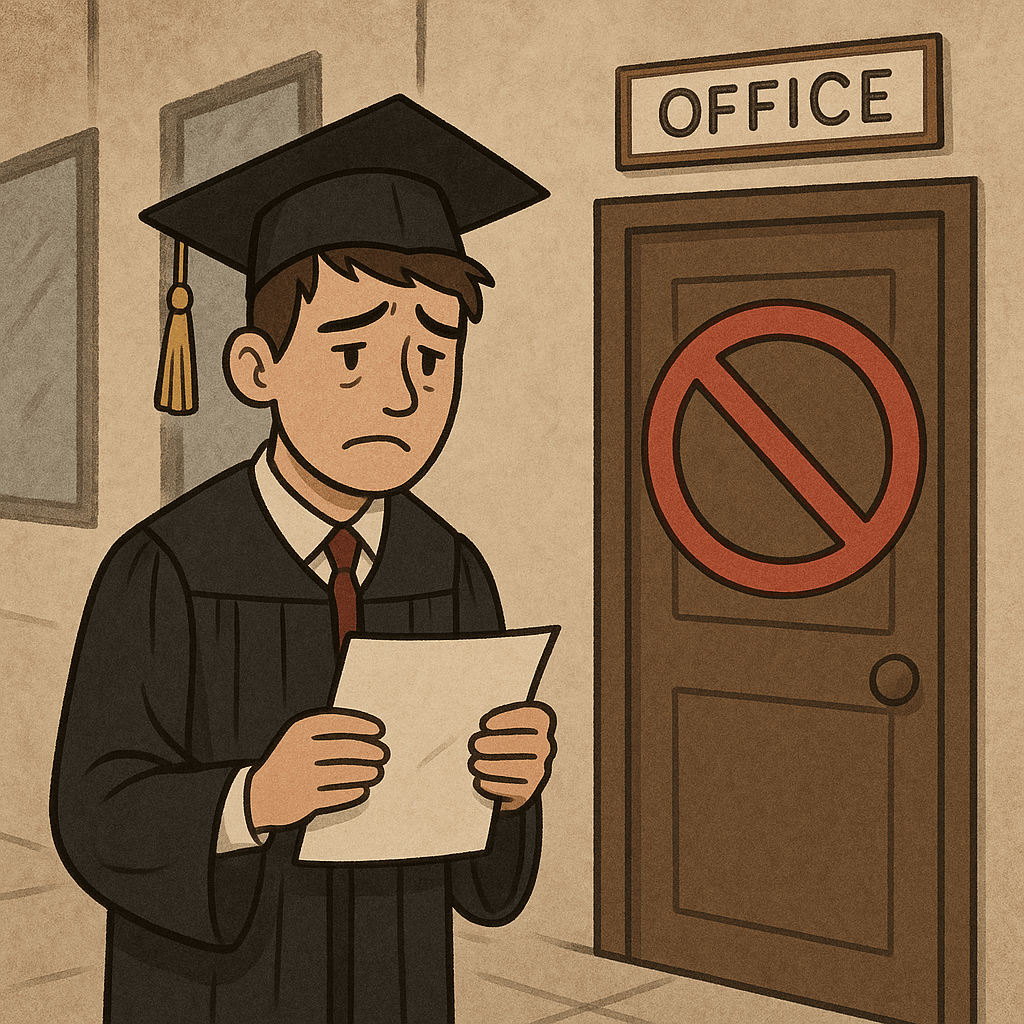
Back in the day, a college degree was largely considered an entry ticket to a stable career path, with some recruitments taking place even before students graduated from college. Today, years after graduation, more and more young people struggle to find their first meaningful job or any job at all, as shown in the figure below from Lichtinger and Hosseini (2025):

At our dinner table, we often discuss this issue with Liqian after every lecture or workshop I give at universities, as we wonder about the morale of students, who are taking double majors, pursuing degrees in once-reliable career accelerators like data science or computer engineering, and spending time on summer/winter internships, while all of that may not mean what it used to.
Then, Liqian shared with me a recently published paper by Guy Lichtinger and Sayed M. Hosseini that takes a stab at this issue by tracking employment dynamics based on the seniority of employers and applicants, and demonstrates that “beginning in 2023Q1, junior employment in adopting [AI] firms declined sharply [by 7.7%] relative to non-adopters, while senior employment continued to rise.”
Lichtinger and Hosseini examined 62 million U.S. workers across 285k firms and 245 million job postings over the past 10 years. The premise here is quite simple: as AI can substitute entry-level jobs, such as “debugging code” or “reviewing legal documents,” junior workers are unable to gain the experience needed to move up the career ladder, as shown in the figure below from Lichtinger and Hosseini (2025):

As companies adopt generative AI, young graduates are not able to gain meaningful entry-level experience and progress from there in their professional careers. Instead, they get stuck in limbo, with little hope of escape. Recently, the lack of hope has already been discussed by business journalist Suzy Welch as an important factor affecting those who enter the workforce and the word “enter” seems like an exaggeration for many lived experiences. Welch argues that in the past, workers “had hope” that their effort would be rewarded with upward mobility; as Welch observes, if you feel your hard work will not pay off, the stress and exhaustion weigh even more heavily on younger generations.
It is not only about the data analyzed by Lichtinger and Hosseini and the observations of Welch, but also about a larger issue for social mobility posed by generative AI. This may be a potential harbinger of the decline of the current post–high school education model, as the authors conclude that,
“Generative AI appears to shift work away from entry-level tasks, narrowing the ‘bottom rungs’ of internal career ladders. Because early-career jobs play a critical role in lifetime wage growth and mobility, these dynamics may carry lasting consequences for inequality and the college wage premium”
(p. 24).
In my own survey conducted last year among US-based Internet users, I asked whether the US education system is adequately preparing students for the digital era. 51.7% of respondents disagreed.
Although in Lichtinger and Hosseini’s sample, early generative AI adopters account for only 3.7% of firms, they may represent a rising trend, if not a looming wave, of societal challenges. After all, it is not just a problem for young people, but a phenomenon with the potential to have a long-lasting impact on our economy and democracy.
Works Cited:
Lichtinger, Guy and Hosseini Maasoum, Seyed Mahdi and Hosseini Maasoum, Seyed Mahdi, Generative AI as Seniority-Biased Technological Change: Evidence from U.S. Résumé and Job Posting Data (August 31, 2025). Available at SSRN: https://ssrn.com/abstract=5425555 or http://dx.doi.org/10.2139/ssrn.5425555
Smith, D. (2025, September 19). Suzy Welch says Gen Z and millennials are burnt out because older generations worked just as hard, but they “had hope.” Yahoo!News. Available at: https://www.yahoo.com/news/articles/suzy-welch-says-gen-z-171251586.html
 Digital Kallipolis