
Last week, I was thinking a lot about the Southwest. Since my first Thanksgiving in 2007, which I spent in New Mexico, I have not been able to stop thinking about the marvels that this part of the United States (US) has to offer. In the past months, the Southwest, and in particular Colorado has also become an epicenter of several fascinating pieces of AI-related legislation that, to some extent, have not received as much attention as, for example, California’s SB 53, which imposes transparency, safety, and whistleblower-protection obligations on developers of frontier AI models.
The ol’Latin proverb says, ‘vox populi, vox Dei’, the voice of the people is the voice of God. AI is definitely one of the hottest topics in recent years, and our legislators seem eager to show how much they care by riding the tide. As much as I am European, over the past years, when Brussels wanted to be a true primus inter pares (first among equals) in AI regulation, I was often worried about whether the lawmakers actually knew what they were even regulating, as the march toward Artificial General Intelligence/Artificial Superintelligence (AGI/ASI) comes with many unknowns and literally a black box of uncertainties.
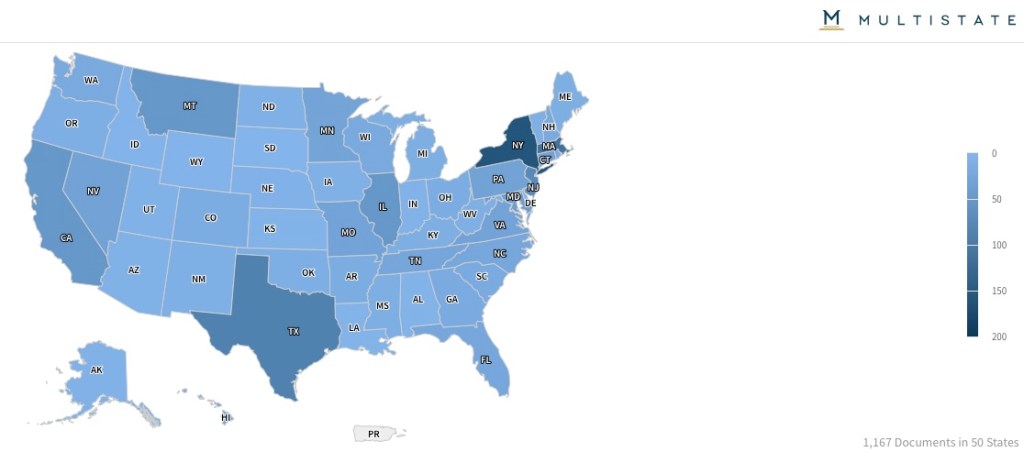
Putting Europe aside the pond, in 2025 in the US, as reported, lawmakers across all 50 states introduced 1,136 AI-related bills, while 136 bills became law. After all, AI is a catchy phrase in state chambers, on Capitol Hill, and inside the White House. Nonetheless, according to Multistate.ai, “110 of 136, or 69%, [of the bills enacted this year on AI] do not contain mandates on private-sector developers or deployers at all” (sic!). In addition, Multistate.ai accounts 671 bills in 47 states in 2024, with 99 enacted, and 136 bills in 37 states back in 2023, with 14 enacted; indicating an exponential increase in AI legislative activity. However, the exact number of proposed bills varies depending on methodology and how those who count them consider bills introduced in sessions that may not align with a single calendar year. Nota bene, democracy can be a mess, and we ought to be better at tracking all of that.
Figure 1. AI Legislative Pieces as of November 2025
Back to Colorado, here is a sample of AI-related legislation that I am talking about. The most groundbreaking is SB 24-205, the Colorado AI Act (CAIA), which provides guardrails for AI use in decision-making in areas such as housing, credit, employment, education, health care, and insurance. It places the burden on the Colorado Attorney General to report on the implementation of the Act, enforcement activity, patterns of non-compliance, and emerging risks related to high-risk AI systems, and on industry to employ risk-management and documentation practices when an AI system has meaningfully contributed to the final outcome of a consequential decision. It is the first bill of its kind in the US that places such statutory obligations on deployers and developers of AI models. Under this law, companies will also need to disclose when they use AI in making consequential decisions. This bill takes effect on June 30, 2026, as per the delayed enforcement timeline established by the SB 25B-004 bill that was passed last August, which opens the possibility for the lawmakers to further amend this bill in the upcoming legislative session. Alongside CAIA, Colorado also created the Colorado AI Impact Task Force, which will sunset on September 1st, 2027, and whose role is to study the social, economic, ethical, and legal impacts of AI across the state; evaluate how AI systems affect Colorado’s workforce, public services, and civil rights; gather input from stakeholders, including industry, academia, and civil society, and provide recommendations to the Governor, the General Assembly, and the Attorney General on future AI policy, safeguards, and regulatory needs.
In addition, HB 24-1147 Candidate Election Deepfake Disclosures Act that was signed on May 24th, 2024, requires candidates for political office to disclose AI-generated content used in their communication and/or other materials, e.g., regarding their opponents. What is more, in 2025, a lot of attention across state legislatures was given to deepfakes involving sexual content, yet only a handful of the proposed bills included obligations for removing such content.
There is also a good ‘oldie’, signed into live on July 6th, 2021, SB 21-169 Restrict Insurers’ Use Of External Consumer Data, which prevents unfair discrimination by insurance providers who use models or algorithms on the basis of race, color, national or ethnic origin, religion, sex, sexual orientation, disability, gender identity, or gender expression. This bill ensures that customers and potential customers are not unfairly treated on the basis of a protected class based on algorithms and predictive models. The bill HB25-1004 prohibiting algorithmic rent-setting was passed and later vetoed by Colorado Governor, Jared Polis on May 29th, 2025.
On the federal level, the staple of Trump’s administration is a pivot toward AI with a simple (common-sense) logic: dominance in the sphere of AI ensures dominance everywhere, and it is the US, not its competitors, that should be at the helm of the path toward AGI. Anything that stands in the way of this goal, for which some have even called for new Apollo-like projects, is viewed as an obstacle, including state-level regulatory measures. Nonetheless, the administration, concerned with the legality of interfering with state law, did not push forward any executive order that could curtail local legislation. However, a call through executive action to investigate state regulation under the Constitution and its Commerce Clause might be a path we will see unfold in 2026, as speculated by The Hill.
Can one agree and disagree at the same time, or regulate without actually regulating (as many of the proposed state-level bills do, given that they do not place obligations on developers and/or deployers)? I agree on the need for a legislative and regulatory response to technological progress. Beginning with how, as a society, we can respond to job displacement and its impact on the social contract where young people may be left without hope and mid-career employees may face repeated layoffs, while also ensuring that protecting consumers, job applicants, and everyone from algorithmic bias and discrimination remains an utmost priority for digital democracies. Creating scattered, fragmented, and often toothless state-by-state AI regulations is not enough to ensure that the future comes with technology that serves humanity rather than replaces us. As we conclude 2025, the US sends a mixed signal of regulatory and deregulatory impulses, while clear signal—not noise—is what is needed as more and more challenges come to light with AI progression.
Works Cited:
Legal Documents
Transparency in Frontier Artificial Intelligence Act, S.B. 53, 2025–2026 Leg., Reg. Sess. (Cal. 2025). https://leginfo.legislature.ca.gov/faces/billTextClient.xhtml?bill_id=202520260SB53
Concerning measures effective no later than June 30, 2026, to increase transparency for algorithmic systems, S.B. 25B-004, 75th Gen. Assemb., 1st Extra. Sess. (Colo. 2025). https://leg.colorado.gov/sites/default/files/documents/2025B/bills/2025b_004_enr.pdf
No Pricing Coordination Between Landlords, H.B. 25-1004, 75th Gen. Assemb., 1st Reg. Sess. (Colo. 2025). https://leg.colorado.gov/sites/default/files/documents/2025A/bills/2025a_1004_enr.pdf
Concerning the use of a deepfake in a communication related to a candidate for elective office, and, in connection therewith, requiring disclosure, providing for enforcement, and creating a private cause of action for candidates, H.B. 24-1147, 74th Gen. Assemb., 2d Reg. Sess. (Colo. 2024). https://leg.colorado.gov/bills/hb24-1147
Concerning consumer protections in interactions with artificial intelligence systems, S.B. 24-205, 74th Gen. Assemb., 2d Reg. Sess. (Colo. 2024). https://leg.colorado.gov/bills/sb24-205
Concerning protecting consumers from unfair discrimination in insurance practices, S.B. 21-169, 73rd Gen. Assemb., 1st Reg. Sess. (Colo. 2021). https://leg.colorado.gov/bills/sb21-169
Other
MultiState. (November 21, 2025). 2025 Enacted AI Laws Report. MultiState. https://www.multistate.ai/2025-enacted-ai-laws-report
Shapero J. and Lane S. Trump mulling executive order to block state AI laws. The Hill. Novermber 19, 2025. https://thehill.com/policy/technology/5613952-trump-considers-blocking-state-ai-laws/
 Digital Kallipolis