
Over the past few years, I have surveyed hundreds of participants and interviewed numerous government, industry, and civil society stakeholders on their perceptions and agency regarding digital footprint (using snowball sampling and in vivo coding). My research assesses public attitudes toward digital and genomic data privacy, offering insights that inform policymaking, civil society activism, and corporate trust and safety standards. This work directly addresses issues impacting corporate trust and safety, especially Very Large Online Platforms.
My subsequent data privacy project explores public attitudes toward Direct-to-Consumer Genetic Testing services, examining the ethical implications of genomic data privacy. I aim to address how companies handle sensitive genetic information, raising essential questions about consent, oversight, and data ownership. After all, unlike with our inbox password, we cannot change (easily, e.g., with CRISPR technology in the future) our DNA, and by exposing ourselves, we do it as well to others related to us, including our genetic relatives and future generations.
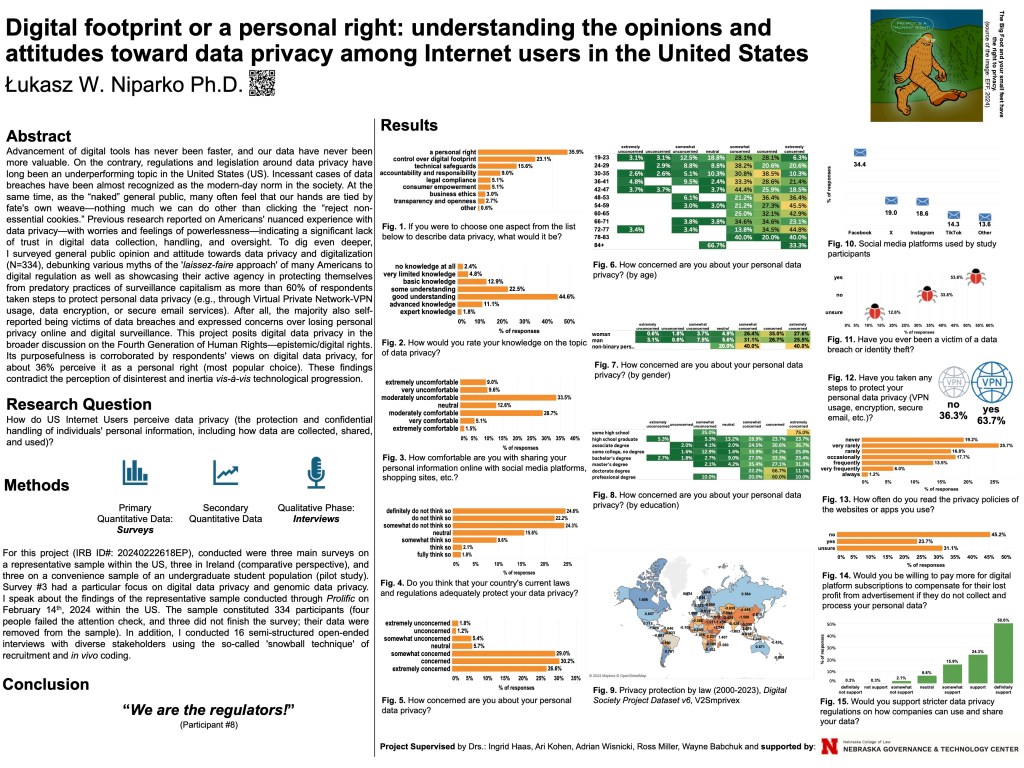
In the winter of 2024, I surveyed general public opinions and attitudes toward data privacy and digitalization. Results revealed that over 60% of respondents had taken steps to protect their data privacy, challenging the perception of Americans’ passive approach to digital regulation. Additionally, I conducted three surveys in the United States, three in Ireland (to provide a comparative perspective from the European Union’s highly regulated digital landscape), and three on an undergraduate convenience sample (pilot studies). A majority of participants reported data breaches and voiced concerns over digital surveillance and privacy loss—findings that fueled my interest in this field. Additionally, I explored global data privacy regimes, including the so-called “Brussels effect,” and integrated perspectives from the Global South to propose frameworks for equitable data governance in an AI-driven world. My research situates digital data privacy within the broader discourse on the Fourth Generation Human Rights—specifically digital rights (Risse, 2021), for 36% of my respondents perceive data privacy as a personal right (a most popular choice). These findings indicate a growing understanding of digital human rights and contradict the perception of disinterest and inertia vis-à-vis technological progression.
Fig. 1. The example of my data privacy work, which I presented at Stanford in 2024 (IRB ID#: 20240222618EP):
 Digital Kallipolis