My research examines the relationship between digital platforms and civil society actors, identifying new forms of advocacy and philanthropy in a data-driven world—also expanding the Digital Civil Society (DCS) concept, focusing on how civic engagement manifests within corporate-owned digital space and grassroots movements. I suggest that DCS represents a ‘new normal’ for civil society, where digital platforms increasingly mediate advocacy, resistance, and community building.
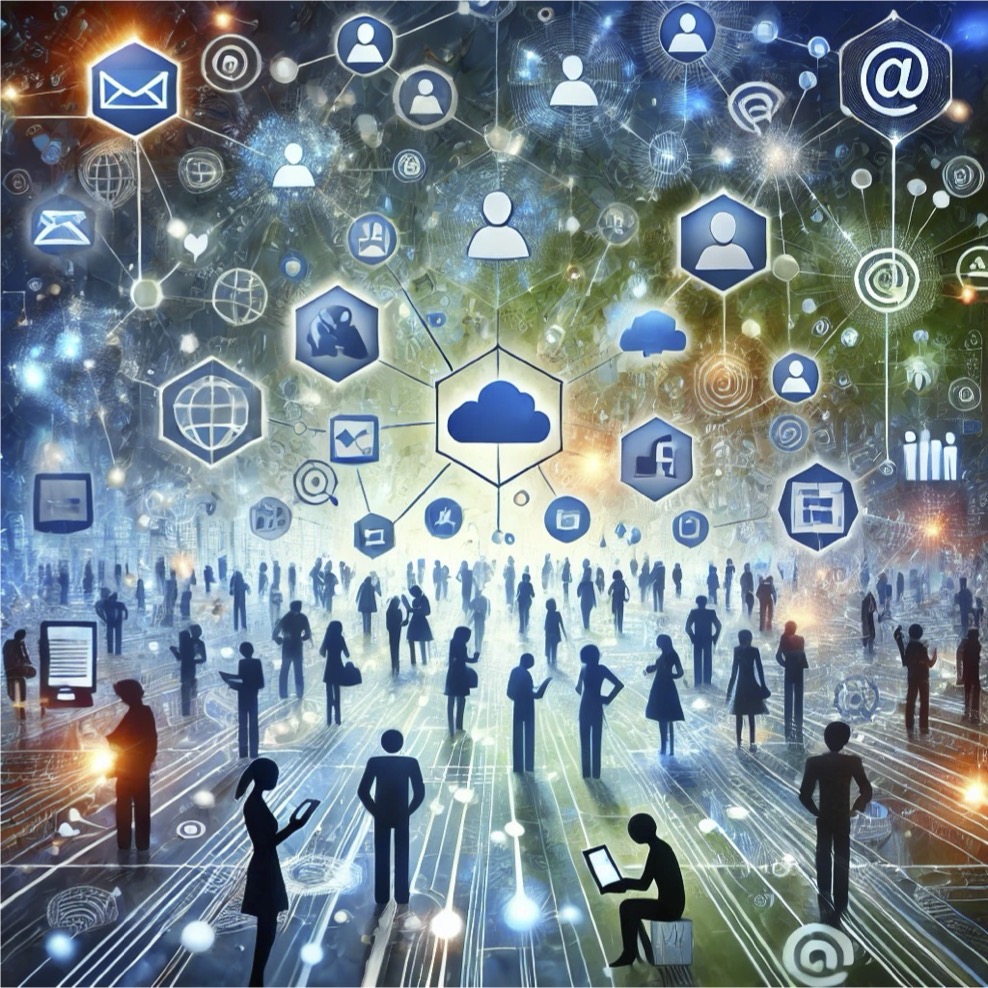
Robert D. Putnam famously noted that we are “bowling alone” in the post-modern era (2000). I propose that today, we are ‘bowling online’. This shift provides new opportunities to quantify DCS’s presence online. I define DCS as occurrences and mobilizations of civil society taking place digitally, e.g., on social media, web forums, and through other virtual communication technologies, or initiating online and continuing in the offline (public) sphere. DCS operates as a complex, interconnected network of netizens (empowered agents of a digital sphere), and their interactions take place within the emerging digital public sphere (DPS).
The absence of clear conceptualization and operationalization of the DPS presents a substantial, potentially existential, challenge to the DCS. We lack physical spaces like the Tahrir Square or Zuccotti Park in the digital sphere. Nonetheless, the creation of the DPS may materialize with further technical advancements, such as with the utilization of virtual reality tools. However, this raises accessibility concerns, particularly for those without the means to access necessary devices or networks. I anticipate data donations becoming a DCS research beacon in the coming years. I am eager to explore this topic further and ensure that my research contributes to a more equitable civic engagement online.
Just as those living in democracy have a say about many aspects of their livelihoods, why not enable them to have more impact on a space where they spend significant time—a digital lifeworld? Enabling and vesting ultimate freedoms can hardly be achieved if we are only mere users of the digital sphere. Since the ultimate ‘good future’ ought to be “by the people” (Lincoln, 1863), the other choice seems to be a form of The Matrix (Wachowski & Wachowski, 1999).
Having in mind all the shortcomings of civil society, e.g., Berman, 1997; Carothers & Barndt, 1999; Wodajo et al., 2021, the public sphere matters, and its existence in the digital sphere could be crucial in maintaining the democratic character of the digital era. The Fourth Generation of Human Rights (4GHR) will vest into every one of us—our netizenship—that will be exercised within the DPS and stemming from a legally binding human rights re-designed system.
However, I hope to go beyond the Habermasian discursive understanding of the public sphere (Habermas, 1991)—to focus on the public sphere as the agora of action that can (when needed) ‘shake’ the Areopagus of power.[1]
Jürgen Habermas considered the public sphere a space connected to discursive exchange that is public—free from governmental or private control or interest. In this space, people come together to exchange ideas and discuss societal issues freely and, through this process, influence political outcomes (Habermas & Burger, 1991). That very public sphere is of great significance to democracy; it enabled Athens to have one and Medieval Europe to embark on the trajectory of Renaissance and Enlightenment. Modernism and post-modernism start on a market square of ideas and goods exchange. Thus, the ultimate question of the current era is the need and potential creation of the DPS, which we lack. The need to define and demarcate the DPS is salient and needs to be thought about more. Is this a moment when we can imagine, after almost solely operating in the US in a corporate-owned digital sphere, that such could be a public one? Not nationalized, not governmentally controlled—but simply public “of the people, by the people, for the people” (Lincoln, 1863). To become netizens, Internet users need space where they can come, gather, sit down, rest, and look around—without fees to pay or data to be taken away from them. Creating a DPS would materialize a 4GHR functioning in a democratic society. It can commence like most of our public spheres, with governmental, public-private partnerships, or private donations, as that of Andrew Carnegie, who transformed the landscape of public educational goods in the US with the establishment of new public libraries (Nasaw, 2007).
It is in the public sphere that Hannah Arendt sees the expression of humanity through Vita Activa—the active life of Homo sapiens where they express their true-self through interaction with others in the public space and enable themselves to unleash their potential, agency, and also potential for power and freedom (Arendt, 1958)—reconfirming the logical assumption that freedom is not only a state but also an act. This act happens in relation to others, where one can notice Hegelian master-slave ties that make each other interdependent (Hegel & Miller, 1998).
[1] In ancient Athens, the Areopagus was a council of former city archons who met on a rocky hill near the Acropolis, known as the “Hill of Ares.” This council originally oversaw legal, religious, and moral matters within the polis and conducted trials in high-stakes cases, such as homicide (Wallace, 2007).
 Digital Kallipolis