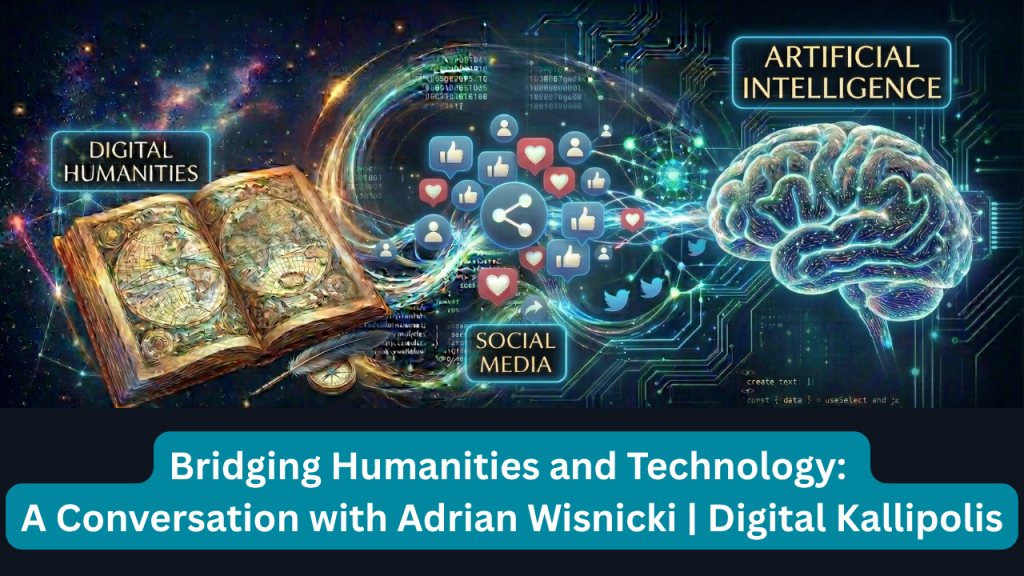
A conversation with Adrian Wisnicki
In this episode, we meet Adrian Wisnicki, University of Nebraska AI Institute Co-Director, a Professor of English at the University of Nebraska-Lincoln (UNL), Faculty Fellow of the Center for Digital Research in the Humanities, and the Digital Humanities Program Coordinator at UNL.
In his professional life, he moved from ‘technology no, no,’ to ‘technology yes, yes’ but with a critical lens used to assess AI and social media. I met Adrian as a graduate student in the program in Digital Humanities which Adrian directed, from there he ended up as the co-chair of my dissertation, titled nomen omen Digital Kallipolis.
In this conversation, Adrian familiarizes us with the concept of Digital Humanities and why do they matter. He discusses his experience with social media and takes on how they could be a more welcoming place. In addition, he focuses on the AI’s impact on society and academia.
You can follow Adrian on social media: https://www.instagram.com/techprofadrian/
Here is Adrian’s visit to Digital Kallipolis. Thanks for stopping by!
Part 1: Digital Humanities
In this part, Adrian defines digital humanities as the dynamic intersection of traditional academic inquiry and modern technology. He explains that while technology allows researchers to uncover hidden data, such as text on damaged manuscripts through spectral imaging, the humanities provide the necessary critical framework to understand our tech-driven world. Wisnicki shares his personal evolution from a traditional literature scholar to a digital researcher, highlighting how a difficult archival project led him to embrace large-scale collaboration. This shift revealed his preference for multidisciplinary teamwork over the isolated ‘single scholar’ model.
Part 2: Social Media
In this part, Adrian describes his professional evolution from a traditional Victorian scholar to a digital humanist deeply engaged with social media. He explains how teaching courses on the intersection of humanity and technology shifted his focus from historical literature to contemporary issues like social media and generative AI. After becoming a full professor, he began producing creative, critical content on platforms like Instagram to provide an academic perspective that challenges industry hype. Wisnicki highlights the physical and ethical costs of AI development, such as exploitative labor, while advocating for a user-controlled future for social media. Ultimately, he views digital platforms as a vital space for scholarly making and resisting the mindless consumption driven by algorithms.
Part 3: Artificial Intelligence
In this part, Adrian explores the multifaceted dangers and potential benefits of generative artificial intelligence. He expresses deep concern regarding environmental damage, the spread of misinformation, and the potential for these tools to erode our shared sense of reality. While he acknowledges that AI can enhance high-level scholarship when used by experts with strong critical thinking skills, he warns against the ‘Eliza effect’. Ultimately, he identifies the greatest threat as the potential for students to offload their cognitive labor to machines. This trend risks undermining the academic mission by replacing rigorous, independent thought with a reliance on fast-evolving technology that students may not yet be equipped to use responsibly.
Here is our entire conversation:
More About Adrian:
Adrian S. Wisnicki is a professor, digital humanist, and scholar who critically explores digital landscapes of social media and artificial intelligence. He serves as Faculty Fellow in the Center for Digital Research in the Humanities, coordinator of the Digital Humanities Program, and co-director of the University of Nebraska AI Institute.
Wisnicki’s academic journey began with a focus on the complexities of Victorian literature and the legacies of British imperialism. He earned his Ph.D. from the City University of New York (CUNY) Graduate Center in 2003, following a B.A. from the University of Chicago and an M.A. from the University of Virginia. As the director of Livingstone Online and the Livingstone Spectral Imaging Project, he led international, multidisciplinary teams in using multispectral imaging to read the faded, illegible diaries of the explorer David Livingstone. This work was recognized by the National Endowment for the Humanities (NEH) as one of its “Great Projects” and was featured on the PBS series Secrets of the Dead.
He has increasingly applied his critical expertise to the governance and ethics of artificial intelligence. His recent research and teaching explore the impact of AI on contemporary society, multi-agent systems, and the preservation of human agency in a technological age. At UNL, he has developed a series of forward-looking courses, including “Artificial Intelligence, the Human, Society” (2026), “AI and Big Tech, Impact and Safety” (2025), “AI, Agents, Superintelligence” (2025), “Human-AI Interaction” (2024), “Artificial Intelligence: Right Now, Tomorrow, and Yesterday” (2023-2024), “Social Media and Big Tech” (2022), and “AI in Fiction, Film, and Culture” (2021) promoting critical AI literacy among students.
Here are some of his Digital Humanities projects:
Undisciplining the Victorian Classroom (2020-)
One More Voice (2020-)
Livingstone Online (2013-2020)
Livingstone Spectral Imaging Project (2011-2019)
Source: University of Nebraska AI Institute. (n.d.). Adrian Wisnicki, Ph.D. https://ai.nebraska.edu/meet-our-people/adrian-wisnicki

