
It is the end of September, and world leaders have gathered in New York City for the United Nations General Assembly (UNGA). The General Debate brings speeches from democratic and autocratic leaders alike. For a few days, each promises to work tirelessly for peace and prosperity at home and around the world… This makes UNGA an apt moment to begin, at Digital Kallipolis, a series on the international laws and policy frameworks we already have to help us navigate the digital (r)evolution and the artificial intelligence (AI) progression, which hopefully have potential to be more tangible than the General Debate speeches…
Since it is the 81st session of the General Assembly, let us start by looking at the Global Digital Compact (GDC) that tries to connect the dots between decades of UN wisdom and the future. I have already written about Article 15(1)(b) of the International Covenant on Economic, Social and Cultural Rights, adopted in 1966 and in force since 1976 (it has 174 state parties that have ratified or acceded to it globally, the latest being Andorra on September 22nd, 2026, the biggest party missing: The United States of America), which recognizes the right to enjoy the benefits of scientific progress and its applications.
On a daily basis, it can feel as though not enough is happening internationally on digital technology and AI law. Yet, a look back at what governments have already agreed reveals a particular agenda. The GDC is one of the clearest blueprints. It was adopted without a vote at the 2024 Summit of the Future as Annex I to the Pact for the Future (I know it reads like a mouthful!). Rwanda and Sweden co-facilitated the early consultations on it; Sweden and Zambia later led the intergovernmental negotiations. Together, Member States set out a shared vision for a more inclusive and humane digital future.
In spite of the fact that the international community has already developed a rich set of legal and policy ideas at the intersection of human rights and digital technology, many of these ideas go unnoticed, even though they offer promising outlines for the safe and equitable development of AI. After all, the crux rests in the questions: Who Decides? We, the people? A handful of founders and CEOs? Governments? Another important question is: Who Is Aware? This is why it is important, in my opinion, to familiarize ourselves with these legal developments. So one day, these legally nonbinding visionary documents can power a better contract between us, states and big tech. After all, the international dimension of AI governance still feels like an underreported story. Yet AI’s development and deployment, from extracting minerals and building data centers to reshaping work, affect us all.
So what does the GDC actually say? Here is a primer. The Pact sets out 56 actions across five chapters and includes two annexes: the GDC and the Declaration on Future Generations. The chapters address: (1) sustainable development and financing for development; (2) international peace and security; (3) science, technology, innovation, and digital cooperation; (4) youth and future generations; and (5) transforming global governance.
The GDC outlines an agenda for an inclusive, open, sustainable, fair, safe, and secure digital future. It sets out objectives, principles and commitments to achieve that vision in the years to come (Yes, if you’ve ever managed a project, you can see how vague it is!). The deadline is 2030… not much time left… Its emphasis on inclusion echoes my home state of Maryland’s “Leave No One Behind” pledge; in the GDC that means narrowing digital divides so the benefits of technology reach people everywhere. Within the Pact, Actions 28-33 address science, technology, innovation and digital cooperation; Annex I develops its digital agenda in greater detail.
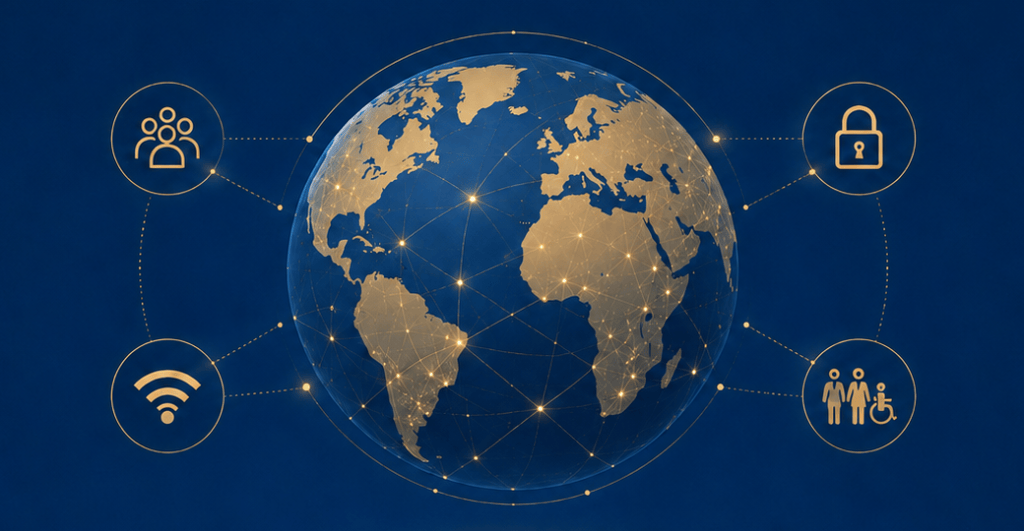
The GDC envisions an inclusive future for technology and AI, one in which countries in the Global South have a meaningful role in shaping digital governance and a fair chance to share in technology’s benefits. It also calls for a human-rights-based approach to the creation and governance of digital spaces and infrastructure, as well as the safe, secure, and trustworthy development and deployment of AI.
Here are the GDC’s key takeaways on AI and technology:
Closing All Digital Divides | The GDC aims to close gaps in access to digital technologies and ensure their benefits are more widely shared.
Achieving Universal and Meaningful Connectivity | The GDC commits to working toward universal, meaningful, and affordable Internet connectivity by 2030, including better service for underserved and rural communities.
Building Digital Literacy, Skills, and Capacities | The GDC promotes equitable access to digital technologies and the development of digital skills for all.
Investing in Digital Public Infrastructure and Goods | The GDC promotes digital public goods, such as open-source software, and supports interoperable digital public infrastructure.
Expanding Inclusion in the Digital Economy | The GDC seeks to make digital markets more competitive, inclusive, and open to innovation and growth, including for micro-, small, and medium-sized enterprises.
Protecting Human Rights Online | The GDC affirms that the same human rights people enjoy offline must also be protected online.
Ensuring Digital Trust and Safety | The GDC calls for stronger safeguards against online violence and abuse, hate speech, child sexual exploitation, and technology facilitated gender-based violence, while protecting privacy and freedom of expression.
Promoting Information Integrity | The GDC calls for international cooperation on media and information literacy, access to reliable information, and responses to misinformation and disinformation that respect freedom of expression.
Advancing Responsible and Interoperable Data Governance | The GDC affirms the right to privacy and calls for responsible, equitable, and interoperable data governance across borders.
Governing Artificial Intelligence for Humanity | The GDC calls for international governance of safe, secure, and trustworthy AI, including an independent scientific panel to assess AI’s risks and opportunities and a global dialogue on AI governance.
The GDC called for two complementary efforts: an independent scientific panel to assess AI’s risks, opportunities, and impacts, and a global dialogue where governments and other stakeholders could discuss AI governance. The General Assembly established both under the GDC in a separate resolution, A/RES/79/325, adopted on August 26th, 2025. The Independent International Scientific Panel on AI, co-chaired by Maria Ressa and Yoshua Bengio, released its preliminary report on July 1st, 2026, and the first annual Global Dialogue on AI Governance convened days later, on July 6th–7th, 2026, in Geneva.
Yet the GDC is a nonbinding political commitment, so its promises still depend on action. Its central test is whether governments, companies, civil society, and all of us turn those promises into measurable change, and whether people know what has been promised and have a meaningful say in what happens next.
The GDC vision comes with a commitment to deliver it by 2030, we have only a few years left to showcase whether it is another empty talk at the UN, or actually something we all mean. The UN has a great skill of developing wish lists of items that would better the world just as GDC portrays, but the time has come for us netizens, citizens, and others to finally keep them and ourselves accountable for delivery. If the UN wants to become relevant as the world moves forward, the time has come to not only deliver laundry lists of beautiful wishes but deliverables. UNGA speeches and nonbinding phrases can be uplifting (or at least make the speakers and institutions feel good about themselves), but to matter, they need to be implemented at street-view level, and of course, that means our awareness and action to accompany them; for as the UNGA teaches, next September they will meet again, and not much will change. Unless we the people decide otherwise.
You can access the GDC here or read it below:
Legal Documents Cited:
International Covenant on Economic, Social and Cultural Rights, adopted on 16 December 1966, United Nations Treaty Series, vol. 993, p. 3. United Nations.
United Nations General Assembly. (2024). The Pact for the Future: Resolution adopted by the General Assembly on 22 September 2024 (A/RES/79/1). United Nations. https://digitallibrary.un.org/record/4061879
United Nations General Assembly. (2024). Global Digital Compact. In The Pact for the Future: Resolution adopted by the General Assembly on 22 September 2024 (A/RES/79/1, Annex I). United Nations. https://www.un.org/pact-for-the-future/en/annex-i-global-digital-compact
United Nations General Assembly. (2025). Terms of reference and modalities for the establishment and functioning of the Independent International Scientific Panel on Artificial Intelligence and the Global Dialogue on Artificial Intelligence Governance (Resolution A/RES/79/325, adopted 26 August 2025). United Nations.

