
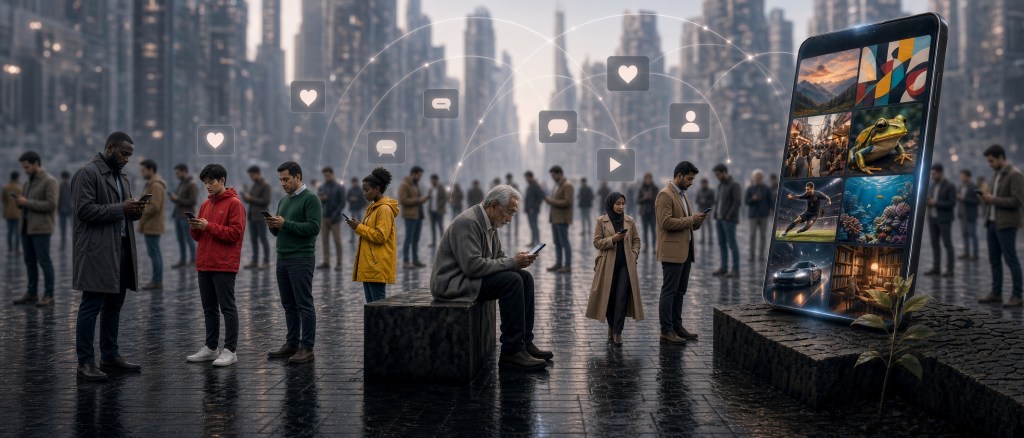
The Social Reckoning, written and directed by Aaron Sorkin, opened in U.S. theaters on Friday, October 9th. Inspired by true events, the film follows the efforts of Facebook whistleblower Frances Haugen and journalist Jeff Horwitz to expose what the company knew about its platforms’ risks to young people’s mental health and their role in fueling political division. The reckoning with social media’s negative impact on all of us has been building, slowly but surely. The warning signs have been accumulating for years: the Cambridge Analytica scandal that erupted in 2018; revelations about Facebook’s role in spreading hatred against the Rohingya in Myanmar during the violence of 2017; and reports of harm to children and teenagers, including cases in which harmful online content contributed to their deaths—*we are finally where we should be years ago: unliking social media.
The Age of Disconnection & the Abyss Facing Young People
Recently, I was introduced to the US Chamber of Connection, a nonprofit that brings local leaders and organizations together to strengthen social connection. The organization also published an informative and quite sobering report, The Six Points of Connection 2026: The State of Connection in America. Its findings echo what the U.S. Department of Health and Human Services (HHS) warned about back in 2023. The U.S. Surgeon General’s advisory noted that approximately half of U.S. adults had reported experiencing loneliness in recent surveys, with particularly high rates among young adults (HHS, 2023, p. 9). The State of Connection report indicates that 83% of U.S. adults fall below its “thriving” category for social connection, while 45% report that they do not trust others. Meanwhile, 72% fall short of the organization’s benchmark for regular one-on-one connection: meeting with friends or relatives at least twice a week. Yet a 2022 Pew Research Center report noted that roughly seven in ten Americans used social media. As Pew Research reported in January 2026, 84% of U.S. adults said they went online at least several times a day. Nonetheless, all that time online does not necessarily translate into meaningful human connection.
The HHS advisory drew a striking comparison between social disconnection and smoking. It explained that a lack of social connection is associated with an increased risk of premature death comparable to that linked to smoking up to 15 cigarettes per day (HHS, 2023, p. 8). We heard this stark warning three years ago. And yet, recognizing the problem is only the beginning. For example, the dangers of smoking are made painfully visible through the graphic health warnings on cigarette packaging in the European Union, which depict smoking’s harmful effects on the body. But loneliness can be much harder to see. It can go unnoticed even by parents and educators, let alone policymakers.
A landmark example illustrating the potential harms of social media for young people was that of Molly Russell (2002–2017). Molly was a 14-year-old British schoolgirl who died on November 21, 2017. She had been exposed to large amounts of harmful online content about depression, self-harm, and suicide, including material recommended by the algorithms used by Instagram and Pinterest. On September 30, 2022, a coroner concluded that she died from an act of self-harm while suffering from depression and the negative effects of online content (Walker, 2022). Despite this and other tragedies, not much changed: Reuters reported in August 2025 that Meta’s internal guidelines had permitted AI chatbots to engage children in romantic or “sensual” conversations. Meta said it removed the relevant provisions after Reuters raised questions. This was just last year! (Horwitz, 2025).
When we allow digital platforms to replace meaningful social ties, we risk falling into the abyss of loneliness. Our children are vulnerable, too; their stories of bullying, self-harm, and loneliness are painfully familiar. According to my own 2024 study using a representative sample, 52% of respondents were concerned about the negative impact of social media on their mental health. About 36% reported experiencing such effects in the 12 months preceding the survey. For many, these harms are personal: 32% of surveyed users reported experiencing online harassment on social media (Niparko, 2024).
The previously mentioned State of Connection in America report indicates that 45% of U.S. adults do not trust others (US Chamber of Connection, 2026). Recent survey research also documents a long-term decline in interpersonal trust in the United States. Pew Research Center’s 2025 report found that 34% of U.S. adults said that “most people can be trusted” in its 2023–24 survey, compared with 46% in the 1972 General Social Survey (Davis, 1992)—a difference of 12 percentage points, or approximately 26% relative to the earlier level. Political science also links political trust to democratic participation and governance, although its relationship with democratic quality depends on context (e.g., Devine, 2024; Hetherington, 1998; Kołczyńska & Bürkner, 2026). For decades, Robert D. Putnam and his collaborators have examined the importance of civic ties to democratic institutions (Putnam et al., 1993), and Putnam has warned about the consequences of eroding social bonds in Bowling Alone (Putnam, 2000). Therefore, the next time someone complains about polarization and radicalization, we need to also consider what we may be cultivating through our screens. “Democracy Dies in Darkness,” the Washington Post’s motto, resonates here. Extending that metaphor to our digital lives, we risk weakening democratic debate when the systems shaping what we see and believe operate as black boxes. In my 2024 study, social media ranked as the fourth most popular source of news among U.S. respondents, followed by personal digital communication platforms (Niparko, 2024). Also, Pew Research Center’s 2025 survey found that 53% of U.S. adults got news from social media at least sometimes, placing it behind news websites or apps (65%), television (64%), and search engines (63%) (Pew Research Center, 2025).
The Time of Reckoning
In a preliminary study I conducted this year, 83% of the active social media users I surveyed in the U.S. stated that they did not trust the social media platforms they used. That distrust raises a broader question: what have these platforms become? In its 2025 antitrust case against the Federal Trade Commission, Meta argued that Facebook and Instagram competed in a broader market that included TikTok and YouTube, challenging the FTC’s narrower definition of a “personal social networking” market (FTC v. Meta Platforms, Inc., 2025). Likewise, users often turn to social media 2.0 for entertainment, to follow news and current events, or to learn new things. My findings suggest that 53% of users use these platforms to stay connected with friends, but only about 10% use them to meet new people (Niparko, 2026). Meta’s platforms remain widely used in the U.S.: 71% of adults report using Facebook and 50% use Instagram, while 37% use TikTok (Pew, 2025). YouTube tops the list at 84%. Yet when we use these platforms as modern-day television sets, do we mistake watching for connecting? The ‘social’ label may reinforce the illusion that consuming content is the same as interacting with others.
These questions also bring trust, safety, and data privacy into focus. In my 2024 research, 76% of respondents viewed data privacy as important, while 35.9% regarded it as a personal right (Niparko, 2024). These changes in perception can also reshape the political and legal climate. On August 26, 2026, Meta reached a settlement with 47 U.S. states, the District of Columbia, and three U.S. territories that requires, among other measures, limits on teens’ use of Facebook and Instagram, stronger age assurance, and independent oversight.
Recently, I had the opportunity to interview Dr. Martine Alonso Marquis, a global expert on relationships and human-to-human connection. We quickly turned to the challenges the digital age poses for our everyday interactions and lasting relationships. Dr. Alonso Marquis calls this reality the “Great Disconnect” and invites each of us to consider what we are becoming as we use these tools. Instead of trying to optimize everything, she suggests, we need to strengthen our capacity to be present. Below, you can hear her reflections on how AI and digital technologies are shaping our lives and relationships:
And with this conversation comes hope. We still have agency—and we should exercise it. The phone is in our hands, and so are the choices we make: getting involved in our communities, volunteering, chatting in an elevator, or smiling at each other. We have spent far too long pursuing connection by outsourcing it to a “black mirror.” In return, the companies behind these platforms harvested our data and drew us into an abyss shaped by algorithms, reinforcement mechanisms that echo B. F. Skinner’s work (e.g., Ferster & Skinner, 1957), and our own deep need for social acceptance, belonging (Baumeister & Leary, 1995), and connection.
On the scale of human evolution, social media is still new. It is only a speck of our shared history. We are still learning how to use these platforms, how to regulate them, and how to respond to their influence—and the moment of great reckoning could not be more urgent. It should have come much earlier, when stronger protections might have helped save young people like Molly Russell. The ecosystem of social media 2.0, where algorithms continually shape what we encounter, can leave us with limited control over what we see. For example, a 2018 Pew survey found that 53% of U.S. adult Facebook users did not understand why some posts appeared in their news feed while others did not (Pew, 2018), while a 2022 Pew survey found that only 10% of Americans thought people had a lot of control over the content they saw on social media (Pew, 2022). Now is the time to take back that control.
The first things we can reclaim, though, are our awareness and self-awareness. And taking a cue from Dr. Alonso Marquis, we can ask ourselves: What are we becoming as we use these tools? How can we prioritize meaning over efficiency? And how can we cultivate a greater capacity for presence?
This post includes references to suicide, self-harm, and emotional distress. If you are struggling or think you may be at risk of harming yourself, please reach out for support. In the United States, you can call or text 988 to reach the 988 Suicide & Crisis Lifeline, available 24/7. If you are in immediate danger, contact your local emergency services. Outside the United States, you can find verified crisis and emotional-support helplines in your country through Suicidal Crisis Support.
*I use em dashes deliberately—to take them back from AI and put them to work in good writing.
Timeline of Events mentioned above:
| Time | Event | Details |
| 1997–2004 | Early social networking platforms emerge (“Social Media 1.0”) | SixDegrees (1997), Friendster (2002), MySpace (2003), and Facebook (2004) launch. |
| 2006–onward | Shift toward feed-driven, advertising-supported platforms (“Social Media 2.0”) | Facebook introduces News Feed in 2006 and Facebook Ads in 2007. |
| August 25, 2017 | Rohingya atrocities | Myanmar’s military launches a campaign of mass atrocities against the Rohingya. Amnesty International concludes in 2022 that Facebook’s algorithms substantially contributed to these atrocities by amplifying anti-Rohingya hatred. |
| November 21, 2017 | Molly Russell’s death | Molly dies at age 14; her case later draws scrutiny of the effects of harmful online content on children. |
| March 17, 2018 | Cambridge Analytica revelations | Whistleblower Christopher Wylie exposes the harvesting of Facebook data for political profiling. Facebook later estimates that up to 87 million users may have had their information improperly shared with Cambridge Analytica. |
| November 5, 2018 | Facebook acknowledges failures in Myanmar | Facebook accepts an independent human rights assessment finding that it had done too little to prevent its platform from fueling division and offline violence. |
| July 24, 2019 | FTC announces a $5 billion privacy settlement | The U.S. Federal Trade Commission announces a settlement to resolve allegations that Facebook violated its 2012 privacy order, including new oversight requirements. |
| October 22, 2019 | Antitrust probe expands to 47 attorneys general | An existing investigation into potential Facebook antitrust violations led by New York expands to include 47 attorneys general, representing states, D.C., and territories. |
| September 14, 2020 | Sophie Zhang’s disclosures | A leaked memo by the former Facebook data scientist, reported by BuzzFeed News, describes Facebook’s failures to address coordinated political manipulation across multiple countries. |
| December 9, 2020 | Federal and state antitrust lawsuits | The FTC and a coalition of 48 attorneys general (46 states, D.C., and Guam) file separate federal lawsuits alleging that Facebook illegally maintained its personal social networking monopoly. |
| September–October 2021 | The Facebook Files and Frances Haugen’s testimony | The Wall Street Journal’s Jeff Horwitz and colleagues report on internal documents provided by former Facebook employee Frances Haugen. She testifies before a Senate subcommittee on October 5 about platform harms and company priorities. |
| September 30, 2022 | Molly Russell inquest conclusion | Coroner Andrew Walker concludes that Molly died from an act of self-harm while suffering from depression and the negative effects of online content. |
| October 24, 2023 | 42 attorneys general sue over youth harms | Thirty-three attorneys general join a federal lawsuit; nine bring separate actions. They allege that Meta designed addictive features and misled the public about risks to children. |
| January 31, 2024 | Five ‘social’ platform CEOs face the Senate | The CEOs of Meta, TikTok, Snap, Discord, and X testify before the Senate Judiciary Committee about online child sexual exploitation and failures to protect children. |
| August 14, 2025 | Reuters investigation into Meta AI chatbots | Reuters finds internal guidelines permitting chatbots to have romantic or sensual conversations with children. Meta says the provisions were erroneous and removed after Reuters’ questions. |
| August 26, 2026 | A multi-state child-safety settlement | Meta announces an agreement with 47 states, D.C., and three U.S. territories, with Texas joining through a parallel consent judgment. The settlement in the federal litigation is approved the same day. The broader deal totals up to approximately $18 billion over ten years, including contingent payments. |
More about Dr. Martine Alonso Marquis:
Dr. Martine Alonso Marquis is a certified executive, relationship, and separation coach whose work centers on leadership, relational health, and meaningful human connection. She holds a Ph.D. in Political Science from Sciences Po Paris and previously served as a foreign policy adviser in the European Parliament. She is Head of Training, Quality & Excellence at key2advance and a co-creator of the Next Generation Leadership Academy. Drawing on 15 years of coaching experience and a life spanning seven countries, Dr. Alonso Marquis works with executives, public servants, researchers, and nonprofit leaders around the world. Through her relationship-focused initiative, heartblooms, she helps people build healthier connections, navigate separation, and move forward with intention. Across her work, she explores how self-awareness, emotional intelligence, and the ability to navigate conflict shape the ways we lead, love, and live together. Learn more about heartblooms here. Watch our full conversation here.
Works Cited:
Amnesty International. (2022). The social atrocity: Meta and the right to remedy for the Rohingya (ASA 16/5933/2022). https://www.amnesty.org/en/documents/asa16/5933/2022/en/
Baumeister, R. F., & Leary, M. R. (1995). The need to belong: desire for interpersonal attachments as a fundamental human motivation. Psychological Bulletin, 117(3), 497.
Cadwalladr, C., & Graham-Harrison, E. (2018, March 17). Revealed: 50 million Facebook profiles harvested for Cambridge Analytica in major data breach. The Guardian. https://www.theguardian.com/news/2018/mar/17/cambridge-analytica-facebook-influence-us-election
Davis, J. A. (1992). General Social Survey, 1972 (Version 1) [Data set]. Inter-university Consortium for Political and Social Research. https://doi.org/10.3886/ICPSR07309.v1
Devine, D. (2024). Does political trust matter? A meta-analysis on the consequences of trust. Political Behavior, 46(4), 2241–2262. https://doi.org/10.1007/s11109-024-09916-y
Facebook. (2007, November 6). Facebook unveils Facebook Ads [Press release]. https://about.fb.com/news/2007/11/facebook-unveils-facebook-ads/
Facebook. (2006, September 8). Facebook launches additional privacy controls for News Feed and Mini-Feed [Press release]. https://about.fb.com/news/2006/09/facebook-launches-additional-privacy-controls-for-news-feed-and-mini-feed/
Federal Trade Commission. (2019, July 24). FTC imposes $5 billion penalty and sweeping new privacy restrictions on Facebook [Press release]. https://www.ftc.gov/news-events/news/press-releases/2019/07/ftc-imposes-5-billion-penalty-sweeping-new-privacy-restrictions-facebook
Ferster, C. B., & Skinner, B. F.(1957) Schedules of reinforcement. Appleton-Century-Crofts. New York.
Gottfried, J., & Park, E. (2025, November 20). Americans’ social media use 2025. Pew Research Center. https://www.pewresearch.org/internet/2025/11/20/americans-social-media-use-2025/
Hetherington, M. J. (1998). The political relevance of political trust. American Political Science Review, 92(4), 791–808. https://doi.org/10.2307/2586304
Horwitz, J. (2025, August 14). Meta’s AI rules have let bots hold ‘sensual’ chats with kids, offer false medical info. Reuters. https://www.reuters.com/investigates/special-report/meta-ai-chatbot-guidelines/
Kołczyńska, M., & Bürkner, P.-C. (2026). Does political trust strengthen democracy? A cross-national longitudinal analysis. International Political Science Review. Advance online publication. https://doi.org/10.1177/01925121251405191
Koumjian, N. (2024, March 27). Publication of IIMM analytical reports [Statement]. Independent Investigative Mechanism for Myanmar. https://iimm.un.org/en/publication-iimm-analytical-reports
McClain, C., & Bishop, W. (2026, January 8). What we know about internet use, smartphone ownership and digital divides in the U.S. Pew Research Center. https://www.pewresearch.org/short-reads/2026/01/08/internet-use-smartphone-ownership-digital-divides-in-u-s/
Meta. (2026, August 27). Our agreement with bipartisan attorneys general: Calling on TikTok and YouTube to join us in supporting teens. https://about.fb.com/news/2026/08/agreement-with-state-attorneys-general-supporting-teens/
Niparko, Ł. W. (Host). (2026, August 20). “I’m here for connection. I’m here for love…” | The B-Effect with Martine Alonso Marquis [Video podcast episode]. In The Butterfly Effect (B-Effect). BE Side By Side LLC. https://youtu.be/tKN_kYoe0GQ
Niparko, Ł. W. (2026). Bowling Online: Accounting for Civil Society Reshaped into Streamlined Photons within a Fiber Network. arXiv. https://arxiv.org/abs/2601.17139
Niparko, Ł. W. (2026). Construing a Digital Kallipolis on the Eve of the Fourth Generation of Human Rights. SSRN. https://papers.ssrn.com/sol3/papers.cfm?abstract_id=6501843
Niparko, Ł. (2026). Study on human decision making and responses [Unpublished raw data].
Niparko, Ł. W. (2024, September 26–27). Digital footprint or a personal right: Understanding the opinions and attitudes toward data privacy among internet users in the United States [Poster presentation]. Trust and Safety Research Conference, Stanford, CA, United States.
Office of the New York Attorney General. (2023, October 24). Attorney General James and multistate coalition sue Meta for harming youth [Press release]. https://ag.ny.gov/press-release/2023/attorney-general-james-and-multistate-coalition-sue-meta-harming-youth
Office of the New York Attorney General. (2019, October 22). Attorney General James gives update on Facebook antitrust investigation [Press release]. https://ag.ny.gov/press-release/2019/attorney-general-james-gives-update-facebook-antitrust-investigation
Office of the Surgeon General. (2023). Our epidemic of loneliness and isolation: The U.S. Surgeon General’s advisory on the healing effects of social connection and community. U.S. Department of Health and Human Services. https://www.hhs.gov/sites/default/files/surgeon-general-social-connection-advisory.pdf
Pew Research Center. (2025, September 25). News platform fact sheet. https://www.pewresearch.org/journalism/fact-sheet/news-platform-fact-sheet/
Putnam, R. D. (2000). Bowling alone: The collapse and revival of American community. Simon & Schuster.
Putnam, R. D., Leonardi, R., & Nanetti, R. Y. (1993). Making democracy work: Civic traditions in modern Italy. Princeton University Press.
Rainie, L., Funk, C., Anderson, M., & Tyson, A. (2022, March 17). Mixed views about social media companies using algorithms to find false information. Pew Research Center.https://www.pewresearch.org/internet/2022/03/17/mixed-views-about-social-media-companies-using-algorithms-to-find-false-information/
Silver, L., Keeter, S., Kramer, S., Lippert, J., Hernandez Ramones, S., Cooperman, A., Baronavski, C., Webster, B., Nadeem, R., & Chavda, J. (2025, May 8). Americans’ trust in one another. Pew Research Center. https://www.pewresearch.org/2025/05/08/americans-trust-in-one-another/
Silverman, C., Mac, R., & Dixit, P. (2020, September 14). “I have blood on my hands”: A whistleblower says Facebook ignored global political manipulation. BuzzFeed News. https://www.buzzfeednews.com/article/craigsilverman/facebook-ignore-political-manipulation-whistleblower-memo
Smith, A. (2018, September 5). Many Facebook users don’t understand how the site’s news feed works. Pew Research Center. https://www.pewresearch.org/short-reads/2018/09/05/many-facebook-users-dont-understand-how-the-sites-news-feed-works/
Solomon, A. (2024, September 30). Has social media fuelled a teen-suicide crisis? The New Yorker.https://www.newyorker.com/magazine/2024/10/07/social-media-mental-health-suicide-crisis-teens
Sony Pictures Entertainment. (n.d.). The social reckoning. https://thesocialreckoning.movie/
The Facebook files. (2021, October 1). The Wall Street Journal. https://www.wsj.com/articles/the-facebook-files-11631713039
US Chamber of Connection. (n.d.). A movement to reconnect America. Retrieved October 7, 2026, from https://www.chamberofconnection.org/
US Chamber of Connection. (2026). The six points of connection 2026: The state of connection in America. https://www.chamberofconnection.org/the-six-points-of-connection-2026
U.S. Senate Committee on Commerce, Science, and Transportation. (2021, October 5). Subcommittee: Protecting kids online: Testimony from a Facebook whistleblower. https://www.commerce.senate.gov/meetings/subcommittee-protecting-kids-online-testimony-from-a-facebook-whistleblower/
U.S. Senate Committee on the Judiciary. (2024, January 31). Durbin presses Big Tech CEOs to protect kids from sexual exploitation online during Senate Judiciary Committee hearing [Press release]. https://www.judiciary.senate.gov/press/releases/durbin-presses-big-tech-ceos-to-protect-kids-from-sexual-exploitation-online-during-senate-judiciary-committee-hearing
Walker, A. (2022, October 13). Molly Russell: Prevention of future deaths report (Report No. 2022-0315). Courts and Tribunals Judiciary. https://www.judiciary.uk/prevention-of-future-death-reports/molly-russell-prevention-of-future-deaths-report/
Warofka, A. (2018, November 5). An independent assessment of the human rights impact of Facebook in Myanmar. Facebook. https://about.fb.com/news/2018/11/myanmar-hria/
Legal Documents cited:
Federal Trade Commission v. Meta Platforms, Inc., No. 1:20-cv-03590-JEB (D.D.C. Dec. 2, 2025) (memorandum opinion, lesser redacted version, ECF No. 705). https://www.ftc.gov/system/files/ftc_gov/pdf/705.pdf
People of the State of California, et al. v. Meta Platforms, Inc., et al., No. 4:23-cv-05448-YGR (N.D. Cal. Aug. 26, 2026) (joint motion to enter consent judgment, ECF No. 572, including proposed consent judgment). https://www.ag.state.mn.us/Office/Communications/2026/docs/05448_Meta_ConsentJudgment.pdf

