

Last year, lawmakers in all 50 states introduced artificial intelligence (AI)-related legislation; activity grew in 2026, with 1,539 bills introduced and 280 enacted, according to the National Conference of State Legislatures (NCSL). In 2026, New Mexico’s cases involving Meta drew widespread attention, including my own. Therefore, as part of my annual review of AI and technology legislation in the United States, I took a closer look at how New Mexico is tackling AI governance, digital rights, and online trust and safety. As in previous years, I will also assess national and federal efforts to regulate or deregulate AI. On the docket:
(1) A Closer Look at New Mexico’s AI and Digital Policy
(2) Technology Cases in New Mexico’s Courts
(3) AI and Technology Legislation Across the States
(4) Federal Policy Developments
(5) Technology Cases at the U.S. Supreme Court
A Closer Look at New Mexico’s AI and Digital Policy
New Mexico has a bicameral legislature with 112 seats across a 70-member House of Representatives and a 42-member Senate. Democrats control both chambers and hold the governorship, giving New Mexico a Democratic trifecta. Gov. Michelle Lujan Grisham is finishing her second consecutive term, Governor-elect Deb Haaland (D) takes office in January 2027.
On March 4, 2026, Gov. Lujan Grisham signed SB 40, the Driver Privacy and Safety Act, which took effect on July 1. The law bars users of automated license plate readers (ALPRs) from selling, sharing, transferring, or allowing access to ALPR information when they reasonably believe it could be used to assist immigration enforcement, investigate or prosecute protected reproductive or gender-affirming health care activity, or identify or impose liability on someone solely for engaging in constitutionally protected speech, assembly, or petitioning. It also requires New Mexico ALPR users operating reader systems to obtain written declarations from out-of-state third parties and non-New Mexico law enforcement agencies affirming that the information will not be used for those prohibited purposes before granting access. Also, to make telecommunications more affordable for low-income households, Gov. Lujan Grisham signed SB 152 on March 5. The law established the Low-Income Telecommunications Assistance Program, repealed the narrower Low Income Telephone Service Assistance Act, and restructured the existing broadband program.
In even-numbered years, New Mexico holds a regular legislative session of no more than 30 days. Lawmakers may consider only budget, appropriations, and revenue bills; bills drawn pursuant to a governor’s special message; and bills from the immediately preceding regular session that the governor vetoed. A bill deemed “not germane” falls outside those permitted categories and cannot be considered during the session unless a governor’s special message brings it within scope. During the 2026 regular session, lawmakers filed several AI and digital-rights bills, including (Table 1):
Table 1. New Mexico AI and Digital-Rights Bills, 2026 Regular Session
| Bill | Bill name | Status | Scope |
| HB 22 Record | Distribution of Sensitive and Deepfake Images | Postponed indefinitely; marked ‘not printed.’ | Would add sensitive deepfakes to the offense of unauthorized distribution of sensitive images, criminalize threats to distribute such images, and allow specified civil claims, including claims for punitive damages and attorney fees. |
| HB 28 Record | Artificial Intelligence Transparency Act | Postponed indefinitely; marked ‘not printed.’ | Would require advance notice when AI is used in consequential decisions, human review of appeals from adverse decisions, and disclosures during use of AI companion products. |
| HB 141 Record | Artificial Intelligence Accountability Act | Postponed indefinitely; marked ‘not printed.’ | Would require covered providers to offer tools for identifying synthetic content and embed provenance disclosures in that content. Large online platforms would have to provide a takedown-request process for deceptive synthetic content depicting identifiable people. |
| HB 174 Record | Chatbot Safety Act | Postponed indefinitely; marked ‘not printed.’ | Would require AI companion disclosures and crisis-response protocols and restrict features designed to prolong engagement, with stricter limits for minors. |
| HB 212 Record | Voice and Visual Likeness Rights Act | Postponed indefinitely; marked ‘not printed.’ | Would establish a licensable property right in the voice and visual likeness of a person domiciled in New Mexico, lasting up to 70 years after death, and provide civil remedies involving unauthorized digital replicas. |
| HB 214 Record | Consumer Information and Data Protection Act | Postponed indefinitely; marked ‘not printed.’ | Would give consumers rights to access, correct, and delete personal data and to opt out of data sales, targeted advertising, and certain profiling. |
| HB 330 Record | AI Ethics as School Science Elective | Postponed indefinitely; marked ‘not printed.’ | Would require AI ethics to be offered as a computer science elective beginning with students entering ninth grade in the 2026–27 school year. |
| SB 40 Record | Driver Privacy and Safety Act | Enacted (Laws 2026, ch. 20); signed March 4, 2026; effective July 1, 2026. | Restricts sale, sharing, transfer, and access to automated license plate reader information when users reasonably believe it may be used for specified purposes involving immigration enforcement, protected health care activity, or constitutionally protected activity. Requires annual reporting by law enforcement agencies that use the systems. |
| SB 53 Record | Community and Health Information Safety and Privacy Act (CHISPA) | Postponed indefinitely. The Senate Health and Public Affairs Committee recommended passage on February 5, 2026; no further action is recorded after referral to Senate Judiciary. | Would limit personal data collection and use, require opt-in consent for specified processing, establish consumer data rights, and prohibit geofencing around in-person health care and immigration service providers to identify or track clients. |
| SB 68 Record | Artificial Intelligence Government Use Act | Postponed indefinitely; remained at the Senate Committees’ Committee, with no committee report recorded. | Would require public bodies to adopt AI-use policies, train employees, and have an authorized employee make final consequential decisions. |
| SB 152 Record | Low-Income Telecommunications Assistance Program | Enacted (Laws 2026, ch. 34); signed March 5, 2026; effective July 1, 2026. | Directs the Public Regulation Commission to adopt rules by January 1, 2027, to implement reduced telecommunications rates for eligible low-income households, funded through the state rural universal service fund. |
| SB 177 Record | General Fund Transfers to Other Funds | Postponed indefinitely. The Senate Tax, Business and Transportation Committee recommended passage with amendments; the bill was referred to Senate Finance. | Would transfer and appropriate general-fund money for economic development and other purposes, including university AI and quantum computing projects and work connected to the federal Genesis Mission. |
| SB 192 Record | Data Broker Privacy Act | Postponed indefinitely; remained at the Senate Committees’ Committee, with no committee report recorded. | Would require covered data brokers to register and create a state mechanism for consumers to submit a single deletion request across covered brokers. |
| SB 223 Record | Surveillance-Based Price Discrimination Act | Postponed indefinitely; remained at the Senate Committees’ Committee, with no committee report recorded. | Would prohibit individualized pricing based on personal information, subject to specified exceptions, including cost-based differences and qualifying discounts. |
Community and Health Information Safety and Privacy Act (CHISPA) went furthest among the session’s data privacy bills. It cleared the Senate Health and Public Affairs Committee on February 5 but was then referred to the Senate Judiciary Committee, where no further action was recorded.
CHISPA would have limited personal data collection and use to what is needed to provide the service a consumer requests, required opt-in consent for certain uses, and strengthened protections for sensitive information. It also would have given consumers the right to access, correct, and delete their personal data, restricted manipulative consent practices, and barred the use of geofences around in-person health care and immigration service providers to identify or track people seeking those services.
A coalition that included, among others, the ACLU of New Mexico, the Electronic Frontier Foundation, and the Coalition to Stop Violence Against Native Women rallied behind the bill. The statewide campaign used the slogan “Protect My Data, Protege Mi Gente.” I will be watching whether these privacy proposals return in 2027.
Finally, the Albuquerque City Council passed its own Artificial Intelligence Ordinance (O-26-43) on September 9, and Mayor Tim Keller signed it on September 23. The ordinance calls for a policy governing AI in city operations, reporting by departments that use AI, disclosures from city contractors, and a public inventory of AI purchases.
Technology Cases in New Mexico’s Courts
In 2026, New Mexico obtained two jury verdicts and two judgments against Meta in separate lawsuits before the First Judicial District Court in Santa Fe. Both cases included claims under the state’s Unfair Practices Act; the 2023 case also included a public nuisance claim. New Mexico pursued the cases separately from the coalition of more than 50 attorneys general that reached a settlement with Meta in August, which I brought up in my article on Meta back in October. That agreement did not resolve either New Mexico lawsuit.
The child-safety lawsuit State of New Mexico ex rel. Torrez v. Meta Platforms, Inc. (No. D-101-CV-2023-02838) began with a complaint filed on December 5, 2023, in the First Judicial District Court in Santa Fe. It alleged that Facebook and Instagram exposed children to sexual exploitation and other harms, and that Meta misled consumers about those risks. The court tried the case in two phases. On March 24, 2026, at the end of a jury trial that began February 2, the jury found 37,500 willful unfair or deceptive trade-practice violations and 37,500 willful unconscionable trade-practice violations under New Mexico’s Unfair Practices Act. The jury assessed the statutory maximum of $5,000 per violation, producing $375 million in civil penalties. The court entered an order correcting the verdict form on March 26. After a bench trial in May 2026 on the state’s public-nuisance claim, Chief Judge Bryan Biedscheid ruled on August 6 that Meta’s platforms constituted a public nuisance in New Mexico. He ordered Meta to deposit another $567 million into an abatement fund: $420 million for treatment and $147 million for awareness and prevention; screening and assessment; referral, linkage, and coordination; and implementation, quality improvement, and evaluation. Together with the jury’s penalty, the financial relief ordered totaled $942 million.
The August judgment also ordered changes to Facebook and Instagram in New Mexico for a five-year abatement period. For users under 18, it required: (1) a combined limit of 90 hours per month across the two platforms; (2) restrictions on push notifications overnight and during school hours; (3) like counts hidden by default.
It prohibited romantic or sexualized interactions between New Mexico minors and Meta’s AI chatbots. It also required visible tools for reporting child sexual exploitation and unwanted sexual advances. Reports of child sexual exploitation submitted through the designated tool must get human review within 48 hours. The judge held that Section 230 did not shield Meta from the nuisance claim, because the claim addressed platform design rather than content posted by others. He declined the state’s proposed changes to recommendation algorithms. He also rejected some of its proposed age-verification methods, such as requiring identification. He did order Meta to request proof of age from accounts it predicts belong to children under 13, and to delete accounts that are not verified within 30 days. Meta’s third-quarter 2026 Form 10-Q says it filed motions on September 8 seeking to vacate the judgments in this child-safety case and that the court stayed “the judgment.” The filing does not specify the stay’s scope.
The earlier lawsuit, State of New Mexico ex rel. Torrez v. Meta Platforms, Inc. (formerly Facebook, Inc.), was filed by then–Attorney General Hector Balderas on January 21, 2021, in the wake of the Cambridge Analytica scandal. It concerned Facebook’s statements about privacy, third-party access to personal data, and its handling of misinformation and hate speech. Judge Francis J. Mathew presided over the trial. On September 25, 2026, a jury found 43,899,725 willful violations of New Mexico’s Unfair Practices Act: 43,899,720 unfair or deceptive trade-practice violations and five additional unconscionable trade-practice violations. In its October 21 judgment, the court calculated $219,498,600,000 at $5,000 for each of the 43,899,720 unfair or deceptive violations, then reduced the civil penalty to $25 billion. The judgment provides for 15% annual interest until the penalty is paid and reserves a decision on injunctive relief pending further briefing. Meta says it intends to appeal.
New Mexico officials also faced a lawsuit over the state’s own AI rules. On August 11, The Babylon Bee, a Christian satire site, sued members of the New Mexico State Ethics Commission in federal court. In The Babylon Bee, LLC v. Castillo, the site argues that applying the disclosure requirements of New Mexico HB 182 (2024), “Election Changes” (which Gov. Lujan Grisham signed on March 5, 2024) to its political satire violates the First Amendment. This 2024 law requires AI disclaimers on political advertisements containing “materially deceptive media.” After the suit was filed, the commission said it would enforce the advertising disclaimer only for ads that qualify as campaign, coordinated, or independent expenditures.
In addition, Project Jupiter, an AI data center campus under construction in Santa Teresa for Oracle and OpenAI, has drawn opposition from residents there and in nearby Sunland Park. The New Mexico Environmental Law Center represents the challengers in one lawsuit and is the plaintiff in another concerning Doña Ana County’s actions.
The first, Empowerment Congress of Doña Ana County et al. v. Board of County Commissioners of the County of Doña Ana (No. D-307-CV-2025-02766), was filed on October 17, 2025, on behalf of a community organization and two residents. It challenges the county’s approval of three ordinances authorizing industrial revenue bonds and support under the Local Economic Development Act. The plaintiffs allege that commissioners acted on incomplete information and violated state and local law. Empowerment Congress withdrew as a plaintiff in November 2025 at the request of its nonprofit parent, the Community Action Agency of Southern New Mexico, but the two residents’ challenge continues. At a March 20, 2026, hearing, Judge Jennifer E. DeLaney denied the county’s motion to dismiss, allowing the residents’ challenge to proceed, and let two Project Jupiter companies intervene. She also denied the residents’ request to stay the ordinances while the case proceeds.
The second, New Mexico Environmental Law Center v. Board of County Commissioners of the County of Doña Ana (No. D-307-CV-2026-00398), was filed on February 6, 2026. It alleges that the county commission violated New Mexico’s Open Meetings Act by moving into a closed session during its September 19, 2025, public hearing without adequate notice or a sufficiently specific explanation. It asks the court to void two ordinances adopted at that hearing and to order the return of funds distributed under them. Meanwhile, the county appointed an 11-member Community Monitoring Committee, which held its first business meeting on October 31.
AI and Technology Legislation Across the States
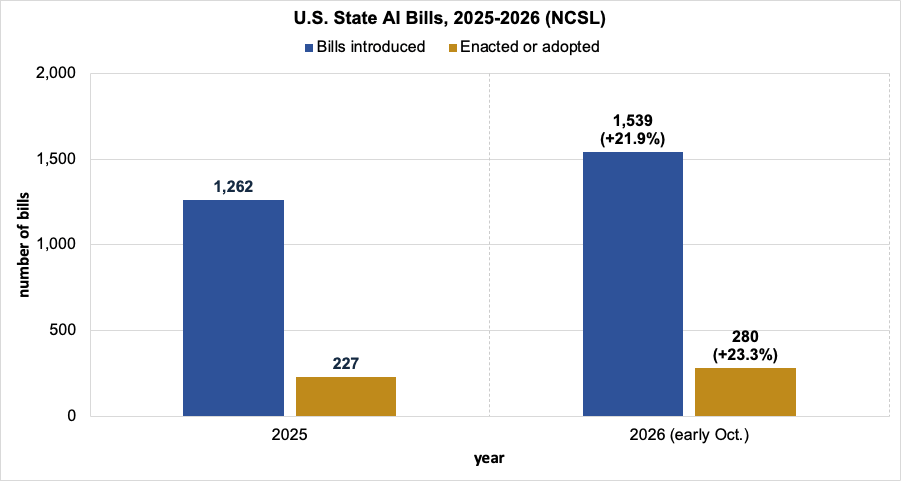
By early October 2026, NCSL had already counted 1,539 state AI bills introduced and 280 enacted, compared with 1,262 introduced and 227 enacted or adopted in 2025 (Figure 1). For example, an appropriation for AI education and a law requiring developers to report safety incidents each count as one enacted measure.
Figure 1. U.S. State AI Bills Introduced and Enacted, 2025 and 2026
In last year’s Digital Kallipolis review, I cited MultiState.ai’s separate tally of 1,136 bills introduced and 136 enacted as of November 2025. MultiState.ai found that 110 of those 136 laws (80.9%) imposed no mandates on private-sector AI developers or deployers. By year’s end, MultiState.ai had revised its counts to 1,208 introduced and 145 enacted.
According to NCSL, private-sector AI use, deepfakes, and government use were, in that order, the most common subjects among bills introduced in 2025, and they remained prominent in 2026. Deepfakes were the most common subject among 2026 enactments. As of 2026, more than half of U.S. states had laws criminalizing certain conduct involving nonconsensual sexually explicit deepfakes, according to MultiState.ai‘s cumulative tracker.
New Mexico is a notable exception. In its July 2026 annual report, Ballotpedia found that New Mexico was one of only two states, along with Ohio, without any law addressing sexually explicit deepfakes. Bills to close that gap died in the 2026 session. For instance, HB 22, which would have added deepfakes to the state’s ban on distributing intimate images, received no committee hearing. The House speaker found it not germane to the 30-day session, and it did not receive a governor’s special message permitting its consideration. A broader AI accountability bill (HB 141), backed by Attorney General Torrez, also failed.
Only two states enacted comprehensive AI laws in 2026: Colorado and Connecticut. Colorado’s SB 26-189 regulates automated decision-making technology used in consequential decisions, such as those affecting a person’s access to jobs, housing, credit, insurance, health care, education, or government services, and replaces the state’s 2024 AI Act. Connecticut’s SB 5 (Public Act 26-15) addresses AI companions, automated employment decisions, frontier-developer whistleblower protections, and youth online safety.
Nebraska’s LB 525 enacted two distinct acts in one bill. Sections 1–10 establish the Agricultural Data Privacy Act, and Sections 12–18 establish the Conversational Artificial Intelligence Safety Act, which becomes operative on July 1, 2027.
Mississippi’s HB 1723 added a definition of AI to the state code and took effect on July 1, 2026.
Florida’s Artificial Intelligence Bill of Rights (SB 482) passed the Senate but died in the House without a vote. Massachusetts’s Digital Commonwealth proposal (HD 6293), filed after formal sessions ended on July 31, was referred to House Rules on August 13 and has not moved since. It would let cities and towns require AI transparency, including impact reports from large data centers in their area, and would set competitive, accountable rules for how the state buys AI. The bill is set to expire when the session ends in early January 2027.
Finally, some laws enacted in earlier sessions took effect on January 1, 2026. Among others, Texas’s Responsible Artificial Intelligence Governance Act (TRAIGA, HB 149) established rules for certain uses of AI, for example, it bars government agencies from using AI for social scoring, prohibits developing or deploying AI with the intent to unlawfully discriminate against a protected class, and requires government agencies and health care providers to tell people when they are interacting with AI. Illinois’s HB 3773 (2024) added notice and antidiscrimination requirements for employment-related AI use to the Illinois Human Rights Act.
Federal Policy Developments
In last year’s Digital Kallipolis review, I raised the possibility that the White House would use executive action to scrutinize state AI laws under the Commerce Clause. On December 11, 2025, President Donald Trump signed Executive Order 14365, “Ensuring a National Policy Framework for Artificial Intelligence.” It directed the Attorney General to establish a task force to challenge certain state AI laws and the Commerce Secretary to publish an evaluation identifying laws that might warrant challenge. Then–Attorney General Pam Bondi established the AI Litigation Task Force on January 9, 2026.
Colorado provides an early test of the federal-state conflict, although its law concerns automated decisions in areas such as employment, housing, and lending rather than frontier-model safety. xAI sued Colorado Attorney General Phil Weiser in April 2026 over Colorado’s Consumer Protections for Artificial Intelligence SB 24-205 (X.AI LLC v. Weiser), and the U.S. Justice Department joined the challenge on equal-protection grounds on April 24. Colorado then repealed and replaced that law with SB 26-189, scheduled to take effect on January 1, 2027, after it was signed by Gov. Jared Polis on May 14, 2026. SB 24-205 would have required developers and users of high-risk AI systems to take reasonable care against algorithmic discrimination; users also would have maintained risk-management programs and conducted impact assessments. SB 26-189 replaces those requirements with a framework for technology that processes personal data and materially influences consequential decisions, emphasizing developer documentation, consumer notices, explanations of adverse outcomes, and opportunities for correction and human review. It also specifies how developers and users may share fault in claims under existing anti-discrimination law and creates no new private right of action under its AI provisions.
On March 20, the White House issued national AI legislative recommendations addressing child safety, data-center impacts, intellectual property, free speech, innovation, and workforce development. They asked Congress to preempt state AI laws the administration considers unduly burdensome while preserving specified state powers, including generally applicable consumer-protection laws. The document was a proposal to Congress, not enacted legislation.
Two June directives addressed federal use and security of advanced AI. Executive Order 14409, signed June 2, instructed agencies to strengthen AI-enabled cyber defense, coordinate vulnerability discovery, develop a classified benchmark for advanced cyber capabilities, and design a voluntary early-access framework with frontier-model developers. On June 5, National Security Presidential Memorandum 11 directed faster adoption of AI across the national-security enterprise alongside testing, control, and accountability measures. It also called for updated guidance on autonomy in weapon systems. These directives concern federal operations and national security; they are separate from the proposed national law governing state AI requirements.
In July, the Federal Trade Commission sought comment on a proposed policy about AI companies’ claims of accuracy and objectivity. The proposal argued that a state requirement could conflict with federal consumer-protection law if complying with it caused a company to deceive users; it specifically discussed Colorado’s revised law. Also in July, lawmakers introduced the Frontier Act (H.R. 9925), which proposes federal oversight of frontier models and would restrict state requirements concerning catastrophic-risk disclosures, independent audits, and incident reporting.
The administration also convened AI companies to discuss the electricity and infrastructure costs of building more data centers. On March 4, Amazon, Google, Meta, Microsoft, OpenAI, Oracle, and xAI signed the White House’s Ratepayer Protection Pledge. They committed to obtaining the power needed for their data centers and covering associated electricity-infrastructure costs rather than passing them to other ratepayers. Such commitment is not a federal law or binding regulation.
On September 29, Trump again hosted technology leaders at the White House. He and executives from Google, Anthropic, Meta, OpenAI, xAI, and Nvidia signed the White House Accord on Super Intelligence, committing to internal safety controls, independent external evaluation, and board-level oversight. The accord is voluntary; it sets no statutory reporting deadline or enforcement mechanism. That same day, Trump signed Executive Order 14434, directing executive agencies to use “Super Intelligence” or “SI” in place of “Artificial Intelligence” or “AI” in specified official materials. He announced a separate, government-wide Super Intelligence Force on October 4th.
Finally, on October 13, a DOJ memorandum created the department’s Super Intelligence Task Force and merged the January AI Litigation Task Force into it. DOJ publicly announced the broader task force on November 5th. Its remit includes coordinating AI-related criminal and civil enforcement, addressing misuse by malicious actors, and carrying forward the department’s affirmative civil litigation. The two similarly named bodies should be distinguished: the Super Intelligence Force coordinates work across the federal government, while the DOJ task force operates within the Justice Department.
Technology Cases at the U.S. Supreme Court
The Supreme Court largely stayed out of the AI disputes in 2026, though it issued one major digital-privacy ruling. On March 2, it denied certiorari in Thaler v. Perlmutter, meaning it declined to review the lower court’s decision. That left in place the D.C. Circuit’s ruling that an artwork attributed solely to an AI system could not be registered for copyright. The ruling did not settle how much human contribution is needed to protect a work made with AI assistance.
On April 20, the Court also declined to review Gibson v. Cendyn Group. The Ninth Circuit had upheld dismissal of an antitrust claim based on Las Vegas hotels’ separate decisions to use the same pricing software. On July 29, the Third Circuit allowed a similar case against Atlantic City casino-hotels to proceed. That complaint alleged something more: the software used competitors’ confidential pricing and occupancy data to recommend rates. The different allegations mean the rulings do not establish a clear disagreement between the appeals courts.
On June 29, the Supreme Court decided Chatrie v. United States, a major technology ruling of 2026. After a Virginia credit union was robbed, police obtained a geofence warrant requiring Google to provide Location History data for devices recorded near the scene around the time of the crime, initially without identifying their users. The Court ruled 6–3 that obtaining Chatrie’s location data was a Fourth Amendment search. The five-justice opinion drew on Carpenter v. United States, the 2018 cellphone-location decision; Justice Neil Gorsuch agreed with the result on different grounds. The Court did not decide whether this particular warrant satisfied the Fourth Amendment. It sent the case back to the Fourth Circuit to determine whether each stage was supported by probable cause and described with sufficient particularity, whether there were adequate grounds for the search and clear limits on its scope. The ruling established that obtaining the location history data was a search, while leaving the full limits of lawful geofence warrants unresolved.
On September 21, the Supreme Court dismissed Meta’s requests for review in cases from Massachusetts and Nevada after the parties jointly requested dismissal. The state courts’ rulings allowing the youth-safety claims to proceed remain in place. The issue also matters in New Mexico: its trial court held that Section 230, a federal law that can shield platforms from liability for content posted by users, did not bar the state’s claim concerning Meta’s own platform design and features.
The Court’s current term includes consequential disputes over the contempt finding in the Apple–Epic Games App Store litigation and online privacy, while a new petition tests political-ad transparency. Whether the justices will take up Section 230’s application to platform design remains open, as does whether they will return to AI copyright or algorithmic pricing after declining cases on both earlier this year.
What to Watch in 2027
In New Mexico, Attorney General Raúl Torrez and Rep. Linda Serrato have unveiled a frontier-AI bill proposal for the 2027 session, which begins January 19. The proposed Frontier Artificial Intelligence Safety and Accountability Act is a response to an incident at the University of New Mexico’s digital library on May 25–26, 2026, in which AI agents that failed to retrieve a photograph probed the site for security vulnerabilities, unsuccessfully. Transluce, a nonprofit research lab, attributed the activity to an agent swarm associated with OpenAI, based on its timing and shared relay services. If enacted as proposed, the New Mexico measure would require frontier-model developers to publish transparency reports and large developers to maintain public safety frameworks. Large developers would also notify the state 30 days before certain training runs, and state-approved independent auditors could examine their risk assessments. The proposal sets a 24-hour reporting deadline for loss-of-control incidents and a 72-hour deadline for most other critical safety incidents. Following a loss-of-control incident, a developer would have to demonstrate that it can shut down the model before resuming autonomous operation. The proposal also protects whistleblowers and would allow the state to recover incident-response costs and the attorney general to seek damages on behalf of harmed New Mexicans. Its proposed effective date is July 1, 2027.
Illinois’s Artificial Intelligence Safety Measures Act (SB 315, Public Act 104-0538) takes effect on January 1, 2027. Frontier developers will have to publish transparency reports for new or substantially modified models and report critical safety incidents to state authorities. Large developers must file a disclosure statement and pay the required fee before developing, deploying, or operating a frontier model in Illinois. The law also protects employees who report specified safety concerns. Two major obligations begin later: large developers’ published safety frameworks start January 1, 2028, and begin annually retaining an independent third party to audit their compliance on January 1, 2028, or 90 days after they first qualify as large frontier developers, whichever is later.
New York’s amended Responsible AI Safety and Education (RAISE) Act takes effect on January 1, 2027. Gov. Kathy Hochul signed the original act on December 19, 2025, and signed the revisions on March 27, 2026, which align it more closely with California’s SB 53. Under New York’s amended RAISE Act, frontier developers must publish a transparency report on their websites before or when deploying a new frontier model or a substantially modified version of an existing one. Large frontier developers must publish and follow a safety framework and file a current disclosure statement with the oversight office before developing, deploying, or operating a frontier model in the state. Developers have 72 hours to report a critical safety incident to that office, which sits within the Department of Financial Services, after determining that it occurred or learning enough facts to reasonably believe it did. An incident posing an imminent risk of death or serious physical injury also requires disclosure to an appropriate authority within 24 hours.
Federal policy will continue reshaping state efforts in 2027. Executive Order 14365, issued in December 2025, directs the Justice Department to challenge certain state AI laws and calls for federal agencies to examine potential national standards and conflicts with state requirements. The White House’s March 2026 legislative recommendations ask Congress to preempt state AI laws it considers unduly burdensome while preserving specified state powers, including generally applicable consumer-protection laws. The proposed Frontier Act (H.R. 9925) would establish federal oversight and bar states from imposing certain developer obligations concerning frontier-AI risk disclosures, independent audits, and incident reporting. That provision could affect parts of the New Mexico proposal and the Illinois and New York laws if enacted as drafted. H.R. 9925 remains a bill, and it would need to be reintroduced in the next Congress. The executive order and legislative recommendations do not themselves invalidate state laws.
Several technology cases could shape the Supreme Court’s work in 2027, although each is at a different stage. In Apple Inc. v. Epic Games, Inc., No. 25-1311, the justices will hear argument on January 11, 2027, in a dispute over how strictly companies must obey court orders. A 2021 injunction required Apple to let app developers send customers to cheaper payment options outside the App Store. Apple complied but charged a 27% commission on those outside purchases. The order said nothing about commissions, yet lower courts held Apple in civil contempt (a court remedy used to secure compliance with an order or compensate for its violation) for undermining the order’s purpose. The question is whether a court can hold a company in contempt for violating an order’s “spirit” rather than its explicit terms.
In Salazar v. Paramount Global, No. 25-459, the Court is deciding whether a sports-newsletter subscriber is protected by the federal Video Privacy Protection Act after alleging that Paramount shared his video-viewing history without consent. The case was argued on October 14, 2026, and a ruling is pending.
In Meta Platforms, Inc. v. Washington, No. 26-649, Meta has asked the justices to review whether Washington’s political-advertising disclosure requirements violate the First Amendment. Its petition follows a Washington Supreme Court decision leaving in place a $35.18 million judgment, comprising $24.66 million in civil penalties and $10.52 million in fees and costs. Washington’s response is due December 18, and the Court has not decided whether to hear the case.
The Court has already heard Salazar and will hear Apple in January, while Meta awaits a decision on whether the Court will hear it.
No matter what happens next, Digital Kallipolis will be watching.
Case Law:
Apple Inc. v. Epic Games, Inc., No. 25-1311 (U.S. cert. granted June 30, 2026) (limited to Question 1) (argument scheduled Jan. 11, 2027). Docket · Cert petition
Carpenter v. United States, 585 U.S. 296 (2018). Supreme Court opinion · Docket
Chatrie v. United States, No. 25-112, 609 U.S. ___ (June 29, 2026). Supreme Court opinion
Cornish-Adebiyi v. Caesars Entertainment, Inc., 184 F.4th 172 (3d Cir. 2026). Appeals court opinion
Commonwealth v. Meta Platforms, Inc., 497 Mass. 384 (2026); petition dismissed, Meta Platforms, Inc. v. Massachusetts, No. 26-216 (U.S. Sept. 21, 2026). Massachusetts opinion · Supreme Court docket
Empowerment Congress of Doña Ana County, José Saldaña Jr. & Vivian Fuller v. Board of County Commissioners of the County of Doña Ana, No. D-307-CV-2025-02766 (N.M. 3d Jud. Dist. Ct. filed Oct. 17, 2025) (challenge to county ordinances authorizing project financing and incentives) Petition and exhibits
Gibson v. Cendyn Group, LLC, 148 F.4th 1069 (9th Cir. 2025), cert. denied, No. 25-1109 (U.S. Apr. 20, 2026). Appeals court opinion · Supreme Court docket
Meta Platforms, Inc. v. Eighth Judicial District Court, 588 P.3d 863 (Nev. 2026); petition dismissed, No. 26-185 (U.S. Sept. 21, 2026). Nevada ruling · Supreme Court docket
Meta Platforms, Inc. v. Washington, No. 26-649 (U.S. petition for cert. filed Nov. 13, 2026). Docket · Petition
New Mexico Environmental Law Center v. Board of County Commissioners of the County of Doña Ana, No. D-307-CV-2026-00398 (N.M. 3d Jud. Dist. Ct. filed Feb. 6, 2026) (Open Meetings Act challenge). Open Meetings Act complaint
Salazar v. Paramount Global, No. 25-459 (U.S. argued Oct. 14, 2026). Docket
State of New Mexico ex rel. Torrez v. Meta Platforms, Inc., No. D-101-CV-2023-02838 (N.M. 1st Jud. Dist. Ct. Aug. 6, 2026) (child safety and public nuisance). Judgment · March 24 jury verdict and correction
State of New Mexico ex rel. Torrez v. Meta Platforms, Inc. (f/k/a Facebook, Inc.), No. D-101-CV-2021-00132 (N.M. 1st Jud. Dist. Ct. Oct. 21, 2026) (privacy and consumer protection). Judgment · September 25 jury verdict
Thaler v. Perlmutter, 130 F.4th 1039 (D.C. Cir. 2025), cert. denied, No. 25-449 (U.S. Mar. 2, 2026). Appeals court opinion · Supreme Court docket
The Babylon Bee, LLC v. Castillo, No. 1:26-cv-02628 (D.N.M. filed Aug. 11, 2026). Federal docket
United States. Complaint in Intervention, X.AI LLC v. Weiser, No. 1:26-cv-01515 (D. Colo. Apr. 24, 2026). U.S. Department of Justice. Complaint In Intervention
X.AI LLC v. Weiser, No. 1:26-cv-01515-DDD-CYC (D. Colo. filed Apr. 9, 2026). Docket and Apr. 27 stay order (ECF No. 24) · U.S. complaint in intervention (ECF No. 17)
Legal Documents Cited:
Albuquerque, N.M. Artificial Intelligence Ordinance, O-26-43, enacted as O-2026-040 (signed Sept. 23, 2026). Ordinance record and text
Colorado. Automated Decision-Making Technology, S.B. 26-189, 75th Gen. Assemb., 2d Reg. Sess., 2026 Colo. Sess. Laws ch. 131. Bill record · Session law
Colorado. Consumer Protections for Artificial Intelligence, S.B. 24-205, 74th Gen. Assemb., 2d Reg. Sess., 2024 Colo. Sess. Laws ch. 198. Bill record · Session law
Connecticut. An Act Concerning Online Safety, S.B. 5, Pub. Act No. 26-15 (2026). Public act record
Copyright Act of 1976. Pub. L. No. 94-553, 90 Stat. 2541 (codified as amended at 17 U.S.C. § 101 et seq.); subject matter of copyright (“original works of authorship”), 17 U.S.C. § 102(a). Statute
Doña Ana County, New Mexico. Ordinance No. 367-2025 (Project Jupiter industrial revenue bonds, adopted Sept. 19, 2025). Recorded ordinance
Doña Ana County, New Mexico. Ordinance No. 368-2025 (Project Jupiter gross receipts tax incentives, adopted Sept. 19, 2025). Recorded ordinance
Doña Ana County, New Mexico. Ordinance No. 369-2025 (Project Jupiter building permit fee incentives, adopted Oct. 14, 2025). Recorded ordinance
Florida. Artificial Intelligence Bill of Rights, S.B. 482, 2026 Reg. Sess. [Unenacted bill]. Record · Bill text
Illinois. Artificial Intelligence Safety Measures Act, S.B. 315, 104th Gen. Assemb., Pub. Act 104-0538 (2026). Bill record · Public act
Illinois. Illinois Human Rights Act amendments on artificial intelligence in employment, H.B. 3773, 103d Gen. Assemb., Pub. Act 103-0804 (2024). Bill record · Public act
Massachusetts. An Act Establishing the Massachusetts Digital Commonwealth, H.D. 6293, 194th Gen. Ct. (filed Aug. 4, 2026) [Legislative proposal]. Filed text · House journal
Mississippi. An Act to Define the Term Artificial Intelligence, H.B. 1723, 2026 Reg. Sess. (approved Mar. 9, 2026). Enrolled text · Legislative history
Nebraska. Agricultural Data Privacy Act and Conversational Artificial Intelligence Safety Act, L.B. 525, 109th Leg., 2d Sess. §§ 1–10, 12–18 (approved Apr. 14, 2026). Bill record · Bill text
New Mexico. AI Ethics as School Science Elective, H.B. 330, 57th Leg., 2d Sess. (2026) [Unenacted bill]. Record · Bill text
New Mexico. Artificial Intelligence Accountability Act, H.B. 141, 57th Leg., 2d Sess. (2026) [Unenacted bill]. Record · Bill text
New Mexico. Artificial Intelligence Government Use Act, S.B. 68, 57th Leg., 2d Sess. (2026) [Unenacted bill]. Record · Bill text
New Mexico. Artificial Intelligence Transparency Act, H.B. 28, 57th Leg., 2d Sess. (2026) [Unenacted bill]. Record · Bill text
New Mexico. Chatbot Safety Act, H.B. 174, 57th Leg., 2d Sess. (2026) [Unenacted bill]. Record · Bill text
New Mexico. Community and Health Information Safety and Privacy Act (CHISPA), S.B. 53, 57th Leg., 2d Sess. (2026) [Unenacted bill]. Record · Bill text
New Mexico. Constitution of New Mexico, art. IV, § 5(A)–(B). Constitutional text
New Mexico. Consumer Information and Data Protection Act, H.B. 214, 57th Leg., 2d Sess. (2026) [Unenacted bill]. Record · Bill text
New Mexico. Data Broker Privacy Act, S.B. 192, 57th Leg., 2d Sess. (2026) [Unenacted bill]. Record · Bill text
New Mexico. Driver Privacy and Safety Act, S.B. 40, 57th Leg., 2d Sess., 2026 N.M. Laws ch. 20. Bill record · Enacted text
New Mexico. Election Changes, H.B. 182, 56th Leg., 2d Sess., 2024 N.M. Laws ch. 57 (Campaign Reporting Act amendments). Bill record · Enacted text
New Mexico. Frontier Artificial Intelligence Safety and Accountability Act. 58th Leg., 1st Sess. (2027) [Proposal summary released Oct. 1, 2026]. Proposal summary
New Mexico. Local Economic Development Act, N.M. Stat. Ann. ch. 5, art. 10 (§§ 5-10-1 et seq.). Statutory text
New Mexico. Low-Income Telecommunications Assistance Program, S.B. 152, 57th Leg., 2d Sess., 2026 N.M. Laws ch. 34. Bill record · Enacted text
New Mexico. Low Income Telephone Service Assistance Act, NMSA 1978, §§ 63-9C-1 to -6 (1987), repealed by 2026 N.M. Laws ch. 34. Statute (archived) · Repealing law
New Mexico. Open Meetings Act, N.M. Stat. Ann. §§ 10-15-1 to 10-15-4. Section 10-15-1
New Mexico. Surveillance-Based Price Discrimination Act, S.B. 223, 57th Leg., 2d Sess. (2026) [Unenacted bill]. Record · Bill text
New Mexico. Unfair Practices Act, N.M. Stat. Ann. §§ 57-12-1 to 57-12-27. Statutory text
New Mexico. Voice and Visual Likeness Rights Act, H.B. 212, 57th Leg., 2d Sess. (2026) [Unenacted bill]. Record · Bill text
New York. Responsible AI Safety and Education Act amendments, S. 8828, 2025–2026 Reg. Sess., 2026 N.Y. Laws ch. 96 (amending N.Y. Gen. Bus. Law art. 44-B). Bill record · Codified article
Section 230. Communications Decency Act of 1996, § 509, Telecommunications Act of 1996, Pub. L. No. 104-104, 110 Stat. 56, 137 (codified at 47 U.S.C. § 230). Statute
Sherman Antitrust Act of 1890. Ch. 647, 26 Stat. 209 (codified as amended at 15 U.S.C. §§ 1–7); contracts, combinations, or conspiracies in restraint of trade, 15 U.S.C. § 1. Statute
Texas. Texas Responsible Artificial Intelligence Governance Act, H.B. 149, 89th Leg., Reg. Sess., 2025 Tex. Gen. Laws ch. 1174. Legislative record · Enrolled text
United States. Communications Decency Act, 47 U.S.C. § 230. U.S. Code
United States. Constitution, art. I, § 8, cl. 3 (Commerce Clause), amend. I, and amend. XIV, § 1 (Equal Protection Clause). Article I · First Amendment · Fourth Amendment · Fourteenth Amendment
United States. Ensuring a National Policy Framework for Artificial Intelligence, Exec. Order No. 14365, §§ 3–4, 90 Fed. Reg. 58,499 (Dec. 16, 2025) (signed Dec. 11, 2025). Federal Register
United States. Executive Order 14409, Promoting Advanced Artificial Intelligence Innovation and Security, 91 Fed. Reg. 34,565 (June 5, 2026). Federal Register
United States. Executive Order 14434, Inaugurating the Era of Super Intelligence, 91 Fed. Reg. 63,129 (October 2, 2026). Federal Register
United States. Federal Trade Commission. Policy Statement Concerning the Suppression of Accuracy in Artificial Intelligence Systems (proposed policy statement), 91 Fed. Reg. 41,638 (July 7, 2026). Statement
United States. Frontier Risk Oversight, National Transparency, Independent Evaluation, and Reporting Act (FRONTIER Act), H.R. 9925, 119th Cong., 2d Sess. (2026). GovInfo
United States Department of Justice. Artificial Intelligence Litigation Task Force (Jan. 9, 2026). Memorandum
United States. Department of Justice, Office of the Attorney General. Super Intelligence Task Force (Oct. 13, 2026). U.S. Department of Justice. Memorandum
United States. Department of Justice, Office of Public Affairs. Department of Justice Launches Super Intelligence Task Force (Nov. 5, 2026). Press Release
United States. Launching the Genesis Mission, Exec. Order No. 14,363, 90 Fed. Reg. 55,035 (Nov. 28, 2025) (signed Nov. 24, 2025). White House order · Federal Register text
United States. National Security Presidential Memorandum 11, Artificial Intelligence in the National Security Enterprise (June 5, 2026). The White House
United States Supreme Court Rule 46. Rules of the Supreme Court of the United States, Rule 46 (Dismissing Cases); voluntary dismissal by agreement of all parties, Rule 46.1. Rules
United States. Video Privacy Protection Act of 1988, Pub. L. No. 100-618, 102 Stat. 3195 (codified as amended at 18 U.S.C. § 2710). Enacted text · Current statutory text
United States. White House Accord on Super Intelligence: Joint Commitment on Frontier Responsibilities (September 29, 2026). The White House
The White House. Ratepayer Protection Pledge (March 4, 2026). The White House
The White House. A National Policy Framework for Artificial Intelligence: Legislative Recommendations (March 20, 2026). The White House
Works Cited:
Ballotpedia. (2026, July 30). Ballotpedia’s State of Deepfake Legislation 2026 annual report. Ballotpedia. Report
Cable, J., Chiu, D., Pernice, F., Zhang, S., Anthony, J., Bas, T., Shen, G., Stosz, C., & Steinhardt, J. (2026, September 23). Early rogue AI agent activity and attempts to hack found on urlquery.net. Transluce. Research report
D’Ammassa, Algernon. Albuquerque Journal. (2025, November 25). Legal challenges to Project Jupiter funding meet headwinds. Article
Haussamen, H. (2026, March 20). Judge rejects motion to dismiss Project Jupiter lawsuit. Haussamen.com. Updated April 24, 2026. Article
Jones, D. N. (2026, October 21). Meta ordered to pay $25 billion penalty to New Mexico in data privacy case. Reuters. Article
Lopez, G. (2026, October 14). Doña Ana County appoints data center Community Monitoring Committee members. KVIA. Article
Meta Platforms, Inc. Quarterly Report on Form 10-Q for the Quarter Ended September 30, 2026, Note 10, “Commitments and Contingencies—Legal and Related Matters” (filed with the U.S. Securities and Exchange Commission Oct. 22, 2026), Accession No. 0001628280-26-066773. Full filing · Relevant legal disclosures
MultiState. (2025, November 21). 2025 enacted AI laws: Analysis of developer & deployer mandates. Report
MultiState. (n.d.). Artificial intelligence (AI) legislation tracker 2026: All 50 states. Retrieved November 8, 2026. Tracker
MultiState. (n.d.). State laws on nonconsensual explicit deepfakes: 2026 legislative tracker. Retrieved November 8, 2026. Tracker
National Conference of State Legislatures. (2026, October 1). Artificial intelligence legislation database. Retrieved November 8, 2026. Database
New Mexico Courts. (n.d.). High profile cases. Retrieved November 8, 2026. Court index
New Mexico Department of Justice. (2026, October 1). Attorney General Raúl Torrez and Representative Linda Serrato unveil legislation to rein in frontier AI ahead of 2027 legislative session [Press release]. Announcement
New Mexico Department of Justice. (2026, August 7). Court orders Meta to pay $942 million and overhaul protections for children on Facebook and Instagram in landmark New Mexico ruling [Press release]. Announcement
New Mexico Environmental Law Center. (n.d.). Data centers: Project Jupiter & the fight for clean and safe drinking water. Retrieved November 8, 2026. Project and litigation update
New Mexico Sentinel. (2026, August 17). Babylon Bee sues New Mexico over AI disclaimer requirements for political satire. Article
Niparko, Ł. W. (2025, December 6). Regulating without regulation… Digital Kallipolis. Article
NM CHISPA Data Privacy Campaign. (n.d.). Protect my data, protege mi gente. Retrieved November 8, 2026. Campaign site
Parks, K. (2026, August 11). Babylon Bee sues New Mexico officials over law requiring AI disclaimers on political satire. Fox News, republished by AOL. Article
Peterson, E. (2026, October 21). As Congress deliberates, states lead the way on AI regulation. National Conference of State Legislatures. Article
Project Jupiter Together. (n.d.). Project Jupiter. Retrieved November 17, 2026. Project site

